
The short version
- Rouen is 1 hour 11 from Paris Saint-Lazare on the fastest direct trains, 34 a day from 5:46, most of them taking 1 hour 15 to 1 hour 30; the last one back leaves Rouen Rive Droite at 21:01. The station sits above the center, with the metro two stops down to Palais de Justice for the cathedral.
- Our private Rouen, Cider and Bayeux day meets your early train at Rouen station: a walk through the car-free medieval center and the square where Joan of Arc was burned, the cathedral, the Impressionists at the Beaux-Arts, lunch at Brasserie Paul, then the drive to the Huet family’s cider farm in the Pays d’Auge for a tasting, and on to Bayeux or Lisieux for the direct evening train, $395 per person with second-class rail, lunch and admissions, four to eight guests.
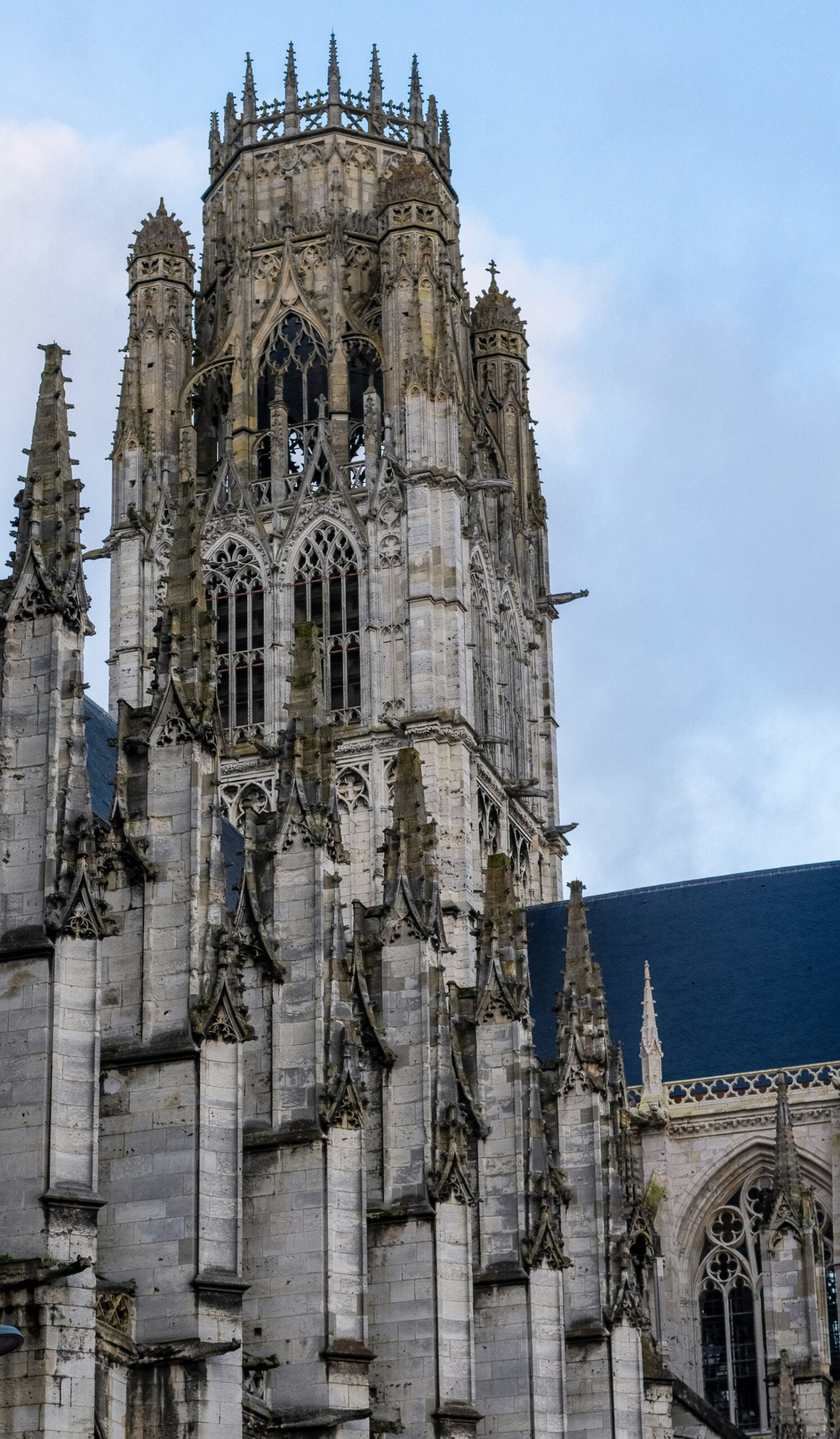
- The cathedral is free, open 9:00 to 12:00 and 14:00 to 18:00 Tuesday to Saturday, afternoons on Monday and all day Sunday. Monet painted its west front from the building opposite in 1892 and 1893, some thirty canvases of the same stones at different hours; one hangs in Rouen’s Beaux-Arts and five at the Musée d’Orsay. The 151-meter cast-iron spire, the tallest in France, came out from under its tarpaulin in April 2026 with the restoration of the summit still to come.
- The Gros-Horloge, the gilded 14th-century clock over the street of the same name, is €7.85 with a 40-minute audio visit up the belfry, Tuesday to Sunday, afternoons only from October to March, and 19 people at a time until May 2027 while its ticket office is rebuilt. The Historial Jeanne d’Arc in the archbishop’s palace, where she was condemned in 1431 and cleared in 1456, is €12, Tuesday to Sunday 10:00 to 19:00.
- The Musée des Beaux-Arts is free, 10:00 to 18:00, closed Tuesday: the Depeaux gift of 1909 made it the largest Impressionist collection outside Paris, alongside Caravaggio, Rubens and Velázquez. The Aître Saint-Maclou, the plague cemetery of 1348 with its galleries carved with skulls and gravediggers’ tools, is free to walk into, Tuesday to Sunday.
- The Armada de Rouen brings the tall ships to the quays from June 17 to 27, 2027, the first time since 2023, when 44 ships drew five million visitors; the hotels go early. The cathedral light show plays on the west front from late May to late September, and the Christmas market fills the cathedral square from November 25, 2026 to January 3, 2027.

What to see
Start at the cathedral. The two west towers are a century apart: Saint-Romain on the left from the 12th century, the Tour de Beurre on the right from the 16th, paid for by donations that bought the right to eat butter in Lent. Inside are the tomb of Rollo, the Viking who founded the duchy, and the heart of Richard the Lionheart. The crypt opens only on the weekend guided visit at 14:30. Brasserie Paul, where our day has lunch, sits on the square opposite, open every day since 1898.
Place du Vieux-Marché is where Joan of Arc was burned on May 30, 1431; a tall cross marks the spot, and the church of 1979 beside it, shaped like an upturned boat, holds 16th-century stained glass saved from a church lost in the war, free to enter. The covered market shares the square, Tuesday to Saturday 7:00 to 19:00 and Sunday mornings. The Historial, in the palace where her trial sat, tells the story in an hour on screens and in the Gothic rooms; the Donjon, the keep where she was shown the torture chamber, opens Tuesday to Sunday 11:00 to 19:00. The tourist office sells a two-hour audio walk through all of it for €5.
East of the cathedral the streets turn to timber: rue Saint-Romain along the Historial, Saint-Maclou with its lace-work Flamboyant front of 1437, the Aître behind it, then rue Damiette and rue Eau-de-Robec for the antiques shops and the stream that runs down the middle of the street. Saint-Ouen, the abbey church at the top, is 137 meters long under 33-meter vaults, with the last great organ Cavaillé-Coll built. Saint-Maclou and Saint-Ouen open on weekends only.
The Beaux-Arts is the museum, free, and its Angrand show is free too, to January 9, 2027; the ironwork museum in a Gothic church, the Flaubert house and the Corneille house are free as well. The antiquities museum and the natural history museum are closed until 2028, the ceramics museum until further notice, and the Panorama XXL on the quay closed for good in 2021, so skip any guidebook that sends you there.
The Seine quays below the old town were turned over to walkers from 1997, 8 kilometers on both banks with parks on the left bank, and they are where the Armada ties up. The cider country is the Pays d’Auge an hour south-west: the Huet family has distilled at Cambremer since 1865, with Camembert, Livarot and Pont-l’Évêque made in the villages around it. No bus goes there; our van does, after lunch.
Getting there and around
The fast trains from Paris Saint-Lazare run nonstop in 1 hour 11 to 1 hour 22, at 6:40, 7:40, 8:40, 10:40 and through the day; the stopping trains take about 1 hour 30 by way of Vernon-Giverny. Coming back, the evening trains leave Rouen Rive Droite at 18:01, 19:01, 20:02 and 21:01, the last, into Paris at 22:23. The station is on place Bernard-Tissot at the top of rue Jeanne-d’Arc, with lockers five minutes away; the metro stop is Gare-Rue-Verte. The tourist office has moved into the Beaux-Arts on the Esplanade Marcel-Duchamp, Monday to Saturday 9:30 to 18:00 in winter, from 10:30 on Tuesdays.
Everything the old town has fits in a walk: the cathedral, the Gros-Horloge, the Vieux-Marché, the Historial, Saint-Maclou and the Aître are within a 2-kilometer loop, and the metro and the TEOR buses cover the hill to the station. Public transport is free on Saturdays. The Lovélo bikes give the first half hour free from 61 stations. The Cathedral car park on place de la Haute-Vieille-Tour was rebuilt in 2025 with 302 spaces and a park on its roof.
Beyond the city is where the train thins out. Bayeux is 2 hours 13 with a change at Caen, 10 trains a day, the last at 19:06, and the last direct train from Bayeux to Paris leaves at 20:13; Lisieux is 1 hour 10. The cider farms of the Pays d’Auge have no bus at all. Our day covers that leg by van: Rouen on foot in the morning, the drive to Cambremer for the tasting, and Bayeux or Lisieux for the evening train to Paris.
The Rouen, Cider and Bayeux day is private, four guests minimum and eight at most, with second-class rail, lunch at Brasserie Paul and all admissions included, $80 more for first class. The Ultimate Normandy Vacation puts Rouen on its fourth day: five days from a Paris hotel with four nights at the Château Saint-Gilles outside Bayeux, Mont-Saint-Michel, the D-Day beaches, Bayeux, Rouen and Giverny, from $3,500 per person for four.
When to go
The Seine valley is oceanic: mild winters, warm rather than hot summers, and rain possible in any month. May to September gives the long evenings and the cathedral light show at 23:00 in June and July, earlier as the nights draw in.
The Armada, June 17 to 27, 2027, is the week the quays belong to the tall ships and the hotels are gone months ahead. The Foire Saint-Romain funfair takes the left-bank quays from October 21 to November 22, the Fête du Ventre fills the Vieux-Marché quarter with Normandy food on a weekend in October, and the Christmas market opens on the cathedral square on November 25, 2026.
Plan around the closed days: the Beaux-Arts on Tuesday; the Gros-Horloge, the Historial, the Aître and the Donjon on Monday; Saint-Maclou and Saint-Ouen on weekdays. The city sites close on January 1, May 1, November 1, November 11 and December 25. The Gros-Horloge opens afternoons only from October to March. For our day, which uses the Beaux-Arts, pick any day but Tuesday.
In winter the cathedral keeps the same hours and the market the same days; what changes is the light, which is low on the west front by mid-afternoon, the hour Monet liked.
Frequently Asked Questions
Is Rouen a day trip from Paris?
Yes, one of the shortest there is: 1 hour 11 on the fast trains from Saint-Lazare, 34 a day, and the last one back at 21:01. Our private day uses the early train out and the evening train home from Bayeux or Lisieux, with Rouen, the cider farm and the drive in between.
Can I see Rouen on my own?
The city, yes. The medieval center is car-free and compact, the cathedral and the Beaux-Arts are free, and the tourist office sells a two-hour audio walk for €5. What you give up is the second half of our day: the cider farm in the Pays d’Auge, which no bus reaches, Bayeux or Lisieux the same afternoon without a change at Caen, lunch booked, and someone to tell you which window Monet stood at.
Where did Monet paint the cathedral?
From a second-floor room in the Bureau des Finances, the Renaissance building facing the west front across the square, in the winters of 1892 and 1893. He finished the series in his studio at Giverny. Rouen keeps one of the canvases in the Beaux-Arts, free to see; the Musée d’Orsay has five.
What should I eat in Rouen?
Canard à la rouennaise, the pressed duckling in its own sauce, is the city’s dish, and Brasserie Paul on the cathedral square is the old address for it. Then Neufchâtel, the heart-shaped cheese from the Pays de Bray, a mirliton almond tart, a stick of sucre de pomme, and cider or Calvados from the Pays d’Auge, which our day tastes at the farm.
Is there a tour from Paris?
Yes. Our private Rouen, Cider and Bayeux day is $395 per person with second-class rail, lunch and admissions, four to eight guests, your guide meeting you at Rouen station; write to us for dates. The Ultimate Normandy Vacation, five days from a Paris hotel, spends its fourth day in Rouen, from $3,500 per person.
Our Most Popular Day Trips From Paris

Rouen, Normandy cider country and the Bayeux Tapestry with a private guide.

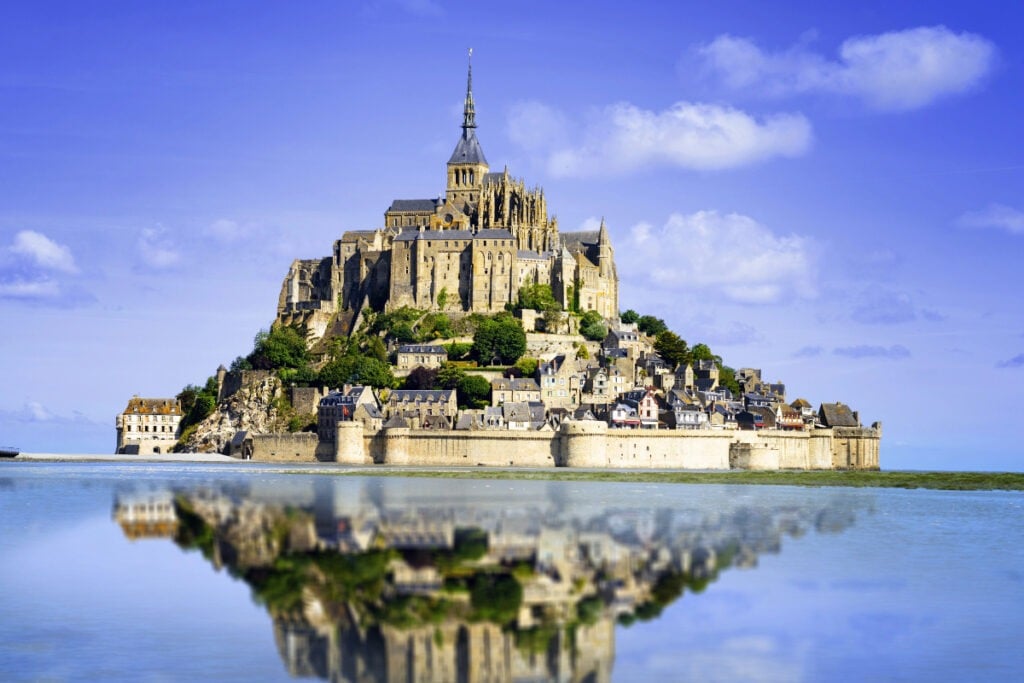
Visit the historic abbey and environs. Marvel at this UNESCO World Heritage site.

Louvre, Montmartre and Notre Dame in eight hours with a private driver-guide.