Paris, the places our day trips go, and the rest of France, one page each
We have been showing people around Paris and the rest of France since 2002. Each page here is about one place: its stories, what to see, and a few tips for the day. Pick one and start reading.
Paris museums and sights
- The Louvre. The biggest art museum in the world started as a fort, and its most famous painting got famous by being stolen.
- Musée d’Orsay. Monet, Renoir, Degas and Van Gogh under the glass roof of a train station that was almost torn down.
- Musée de l’Orangerie. Monet gave France his Water Lilies the day after the Great War ended, and an old greenhouse for orange trees became their home.
- Musée Rodin. The Thinker sits in a garden beside Les Invalides, and the sculptor who made him was turned down by art school three times.
- Musée Picasso. The Picassos that Picasso kept for himself, in a Marais mansion built on salt-tax money.
- Musée Marmottan Monet. The painting that gave Impressionism its name hangs in a quiet townhouse in the 16th, and thieves once walked out the door with it.
- Musée Carnavalet. The attic of Paris: Proust's bed, a model of the Bastille, a whole Art Nouveau jewelry shop, and it costs nothing to walk in.
- Centre Pompidou. Paris built a museum with its pipes on the outside, called it an oil refinery, then fell in love with it. It is closed until 2030.
- Palais Garnier. An unknown 35-year-old won the contest, the empress is said to have hated his design, and a lake under the stage gave the Phantom a home.
- Les Invalides. Louis XIV built it for his old soldiers, a mob armed itself here in 1789, and Napoleon lies under the gold dome in six coffins.
- The Panthéon. A king built it as a church, the Revolution filled it with heroes, and Voltaire and Rousseau have been stuck facing each other ever since.
- The Catacombs. Paris ran out of room for its dead, so it moved them into the old stone quarries by night. You can walk through.
- Sainte-Chapelle and the Conciergerie. A king's jewel box made of glass, and next door the prison where a queen waited for the guillotine.
- Notre-Dame. It took almost two hundred years to build, one novel to save, and five years to bring back from the fire.
- The Eiffel Tower. It was supposed to stand for 20 years, half of Paris wanted it gone, and a con man once sold it for scrap.
- Arc de Triomphe. Napoleon ordered it, never saw it finished, and finally passed under it in his coffin.
- Sacré-Cœur. The white church on the hill washes itself in the rain, and someone has been praying inside it day and night since 1885.
- Père Lachaise. Nobody wanted to be buried here until the city moved in a few celebrities. Now Chopin, Oscar Wilde, Édith Piaf and Jim Morrison share one hillside.
Paris neighborhoods
- Le Marais. A swamp, then a royal address, then a slum nobody bothered to tear down, which is why the oldest streets in Paris are still here.
- Montmartre. A hill of windmills and cheap rent, where Renoir painted the dances, Picasso drank on credit and the vineyard still makes wine.
- Saint-Germain-des-Prés. Monks, then philosophers, then shoppers, with two famous cafés staring at each other and the best garden in Paris at the end.
- The Latin Quarter. Eight hundred years of students, one Roman bathhouse, and a hill with the heroes of France buried on top.
- Île de la Cité and Île Saint-Louis. Paris began on one island 2,000 years ago and still goes for ice cream on the other.
- Canal Saint-Martin. Napoleon dug it for drinking water and paid for it with a tax on wine, and Paris now drinks wine beside it.
- Belleville. A hill village that Paris swallowed in 1860, with a loud market, a painted street, cheap noodles and the best free view in town.
- Champs-Élysées and the 8th. A royal garden path that became the most famous avenue in the world, with an arch at the top and the guillotine's old address at the bottom.
- Bastille and the 11th. The prison is gone and its key is in Virginia. What's left is two great markets, a garden on a railway bridge and the city's late nights.
- The 7th Around the Eiffel Tower. A tower that was supposed to come down after 20 years, an emperor in six coffins, a sculptor's garden and the best picnic street in Paris.
Getting around Paris
- CDG to Paris. Train, taxi, bus or a driver holding your name on a sign: four ways into Paris, and the one we'd pick after a night on a plane.
- Orly to Paris. The older, smaller Paris airport is now one driverless metro ride from the middle of town.
- Metro, RER and Navigo. The Paris Metro has been running since 1900, and a ride anywhere in the region costs the same. A phone or one small card is all you need.
- The Paris Museum Pass. One card opens more than fifty museums and monuments, including a few you would never have paid to see and will be glad you did.
- What’s Closed on Mondays and Tuesdays. Half the big museums in Paris take Monday off and the other half take Tuesday, so there is always somewhere good to go.
- The Six Paris Train Stations. Paris has six big train stations, each pointed at a different corner of France, and each with a story or two.
- Seine Cruises. An hour on the river takes you past a bridge called New that is the oldest in town and a stone soldier who measures floods.
- Paris Markets. Parisians still shop two or three mornings a week from a vendor who wants to know when they plan to eat the melon.
- Sundays in Paris. France made Sunday a day of rest by law in 1906, and Paris still takes it seriously. The trick is to join in.
Where to stay in Paris
- 25 Interesting Hotels in Paris. A public pool, a post office, a bank, a brothel, a prince’s mansion, and the palaces where history happened.
Where our day trips go
- The D-Day Beaches. Omaha, Utah, Pointe du Hoc and the American Cemetery, along 50 miles of Normandy coast where June 6, 1944 still feels close.
- Bayeux. The first town in France freed after D-Day came through the war without a scratch, cathedral, water wheel and all.
- Mont-Saint-Michel. An abbey on a rock in a bay with the highest tides in Europe, begun because an archangel would not take no for an answer.
- Saint-Malo and Dinan. A walled city that got rich on licensed piracy, and a medieval town upriver that never saw a reason to change.
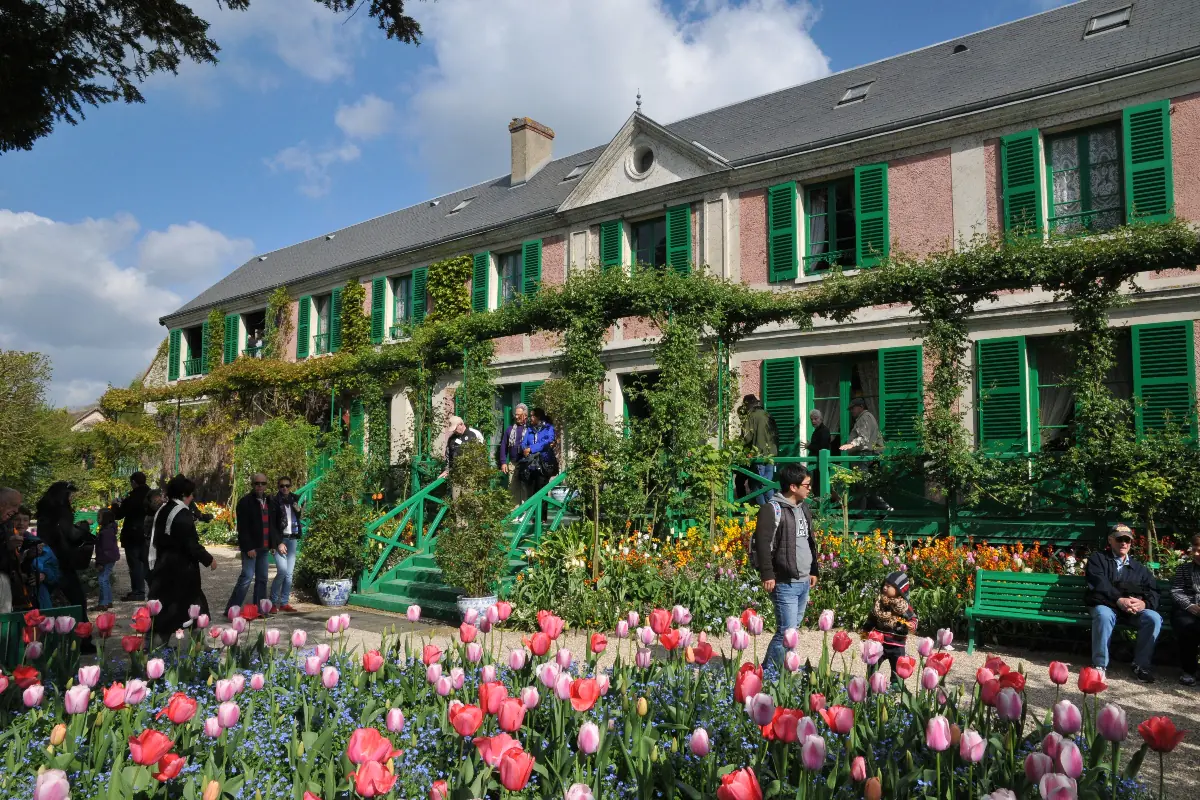
- Giverny from Paris. Monet spotted this village from a train window, moved in, and spent 43 years turning a garden into his favorite painting.
- Versailles. A hunting lodge that became the seat of France, where handing the king his shirt was an honor people fought over.
- Fontainebleau and Vaux-le-Vicomte. One château got its owner arrested, and the other is where Napoleon said goodbye, both an hour south of Paris.
- The Loire Valley Châteaux. A hunting lodge with 426 rooms, a château built across a river, and the town where Leonardo da Vinci spent his last years.
- Reims and Champagne. France crowned its kings in the cathedral, a young widow fixed the wine, and the monk who gets the credit was trying to stop the bubbles.
- Strasbourg. A French city that looks German, with a cathedral that was the tallest building in the world for two centuries.
- Colmar and the Alsace Wine Villages. Painted houses, storks on the chimneys and a wine road through villages that look borrowed from a fairy tale.
- Lyon. France's food city has secret passages, a basilica the locals call the upside-down elephant, and the street where the movies were born.
- Avignon. Seven popes lived here instead of Rome, the famous bridge stops halfway across the river, and nobody ever danced on it.
- Arles, Les Baux and Saint-Rémy. The town where Van Gogh painted 200 pictures, the asylum where he painted The Starry Night, and the rock between them.
- Bordeaux and Saint-Émilion. A wine village carved out of limestone and the city that got rich selling its wine to the English, two hours from Paris.
- Beaune and Burgundy. Monks mapped these vineyards row by row, a duke outlawed a grape, and a hospital still pays its bills with a wine auction.
- Rouen. Joan of Arc died here, Monet painted the cathedral about thirty times, and Julia Child ate the lunch that changed her life.
- Caen. William the Conqueror built a castle and two abbeys here, and he is still in one of them, more or less.
- Verdun and the Western Front. The longest battle of the First World War was fought on these hills for 300 days in 1916, and the ground still shows it.
- Cognac. A small town on the Charente river makes the world's most famous brandy, and its walls have turned black from it.
- Aix-en-Provence. A town of fountains, plane trees and café tables, where Cézanne painted the same mountain for most of his life.
- Orange and Châteauneuf-du-Pape. A Roman theater with its stage wall still standing, and a wine village that once banned flying saucers.
- The Luberon. Stone villages on a long ridge east of Avignon, with red cliffs, a bottomless spring and a castle that belonged to the Marquis de Sade.
- Pont du Gard, Nîmes and Uzès. A Roman aqueduct, the city it carried water to, and the market town where the water began.
- The Lavender Fields of Provence. Three weeks of purple, a 12th-century abbey, and a smell that reaches you before the fields do.
- Arcachon and the Dune du Pilat. Europe's tallest sand dune, a bay full of oysters and a hillside of fairy-tale villas, an hour from Bordeaux.
- Dijon. The dukes of Burgundy were once richer than the kings of France, and their old capital still eats and drinks like it.
- The Médoc. A flat strip of gravel north of Bordeaux grows some of the most expensive red wine on earth, behind gates that mostly stay shut.
Near Paris and the north
- Chantilly. A castle full of Raphaels, stables built like a palace for horses, and the town that put its name on whipped cream.
- Chartres. A cathedral that burned and came back in one generation, with 800-year-old blue glass and a maze in the floor.
- Honfleur, Deauville and Étretat. A harbor the Impressionists loved, a boardwalk built for showing off, and chalk cliffs Monet nearly drowned painting.
- Amiens. The biggest cathedral in France, vegetable gardens you visit by boat, and the house where Jules Verne wrote his way around the world.
- Lille. An hour from Paris and half Flemish, Lille has gabled squares, beef stewed in beer and the biggest flea market in Europe.
- Troyes. A town shaped like a champagne cork, with leaning timber houses, churches full of old stained glass and a sausage with its own fan club.
Brittany and the Atlantic
- Carnac and the Gulf of Morbihan. Three thousand standing stones older than the pyramids, a walled town with a market, and a little sea full of islands.
- Finistère. Brittany's far west has Atlantic cliffs, a drowned city, a bent cathedral and the best butter cake in France.
- Nantes. The city of Jules Verne has a 40-foot mechanical elephant, a castle that changed French history twice and a green line to follow.
- La Rochelle and Île de Ré. A harbor guarded by medieval towers, a siege out of The Three Musketeers, and a flat island of bike paths across the bridge.
The Riviera, Provence and Corsica
- Nice. The Greeks named it for victory, the English built its seafront, and Matisse came for one winter and stayed 37 years.
- The Riviera Villages. Six small places near Nice, with a prince, a philosopher, several painters and a great many lemons.
- Saint-Tropez. A fishing port with a headless saint, a painter's yacht and Brigitte Bardot in its past, and still no train station.
- Porquerolles and the Îles d’Or. A car-free island that a husband once bought as a wedding present, fifteen minutes by boat from the coast near Hyères.
- Marseille. The oldest city in France is a loud, salty port with an island prison, a golden Virgin on the hill and a fish stew with its own rulebook.
- Cassis and the Calanques. A small fishing port, white cliffs that drop into clear water, and a painted cave hidden under the sea.
- The Gorges du Verdon. A canyon close to half a mile deep that nobody had traveled end to end until 1905, with a turquoise lake at its mouth.
- Corsica. A mountain range in the sea with its own language, its own flag and the house where Napoleon was born.
The Southwest, Languedoc and the Pyrenees
- Montpellier. A sunny university city where Rabelais became a doctor, Nostradamus got thrown out, and half the people on the square look twenty.
- Collioure and the Côte Vermeille. A fishing harbor where the Pyrenees meet the Mediterranean, and where Matisse spent one summer and changed painting.
- Carcassonne. Two rings of walls, 52 towers, a legend about a pig, and the castle every kid has drawn at least once.
- Toulouse. The pink city, built of brick and paid for with blue dye, where a saint met a bull and the Concorde first flew.
- Albi and Cordes-sur-Ciel. A red-brick cathedral built like a fortress, the hometown of Toulouse-Lautrec, and a hilltop village that floats above the fog.
- Lourdes and the Pyrenees. A 14-year-old girl, a cave by a river, candles by the thousand, and some of the grandest mountains in France just up the valley.
- Biarritz and the Basque Coast. An empress made it fashionable, a Hollywood screenwriter brought the first surfboard, and the Basques were here long before either.
- The Dordogne. Painted caves, rival castles glaring across a slow river, and more duck than you thought one region could cook.
The Alps, the East and the Center
- Annecy. Canals, a castle and one of the cleanest lakes in Europe, in a town that only became French in 1860.
- Chamonix. The town where mountain climbing began, under the highest peak in the Alps, with a cable car that does the climbing for you.
- Nancy. A king without a kingdom built one of the prettiest squares in Europe here, and the town later invented its own Art Nouveau.
- The Auvergne Volcanoes. About eighty sleeping volcanoes in a row, a black cathedral built of lava and some of the best cheese in France.
Deciding between tours rather than reading about a place? The Trip Planning pages compare them side by side.