The short version
- Start by the river and walk uphill. The quarter climbs from the Seine to the Panthéon, and rue Mouffetard takes you down the far side.
- Pick one museum. The Cluny is for the Middle Ages, and the Panthéon is for the famous dead.
- Skip the restaurants around rue de la Huchette. A menu in four languages and a man waving you in are the warning.
- Walk it with a licensed guide and a pastry!

The walk
The Saint-Michel fountain
Everybody in Paris has waited for somebody in front of this fountain. It went up in 1860, when Baron Haussmann cut the boulevard through the old streets, and it shows the archangel Michael standing on the devil. This is the bottom of the student hill. Everything from here is up.
Shakespeare and Company
An American named George Whitman opened this bookshop in 1951 and let traveling writers sleep among the shelves. The deal was to help out for a couple of hours, read a book a day and write one page about your life. Some 30,000 people have taken him up on it. His daughter Sylvia runs the shop now, and the beds are still there. Expect a line on weekends.
The oldest tree in Paris
It is the scruffy one leaning on concrete crutches in the square René-Viviani, behind the bookshop. A royal gardener named Jean Robin planted it in 1601. Then walk up rue Saint-Jacques and step into the church of Saint-Séverin. Go around behind the altar, where one stone pillar twists like a palm tree and spreads into the ceiling.
The Musée de Cluny
The Romans built public baths here around the year 200, and one cold-water hall still has its roof. In the 1400s the abbots of Cluny built a town house on top. Inside are the six Lady and the Unicorn tapestries, found in a damp castle in the 1840s with rats working on the edges. Look for the stone heads too. Revolutionaries knocked them off Notre-Dame, thinking they were kings of France, and they turned up in 1977 under a bank.
The Sorbonne
Robert de Sorbon, the king’s chaplain, opened a college here in 1257 for theology students with no money. It grew into the most famous university in Europe. In May 1968 its students took over the building and pulled up the paving stones to throw at the police. ‘Under the paving stones, the beach,’ said the graffiti. The courtyard is closed to visitors, so the square out front is the place to stop.
The Panthéon
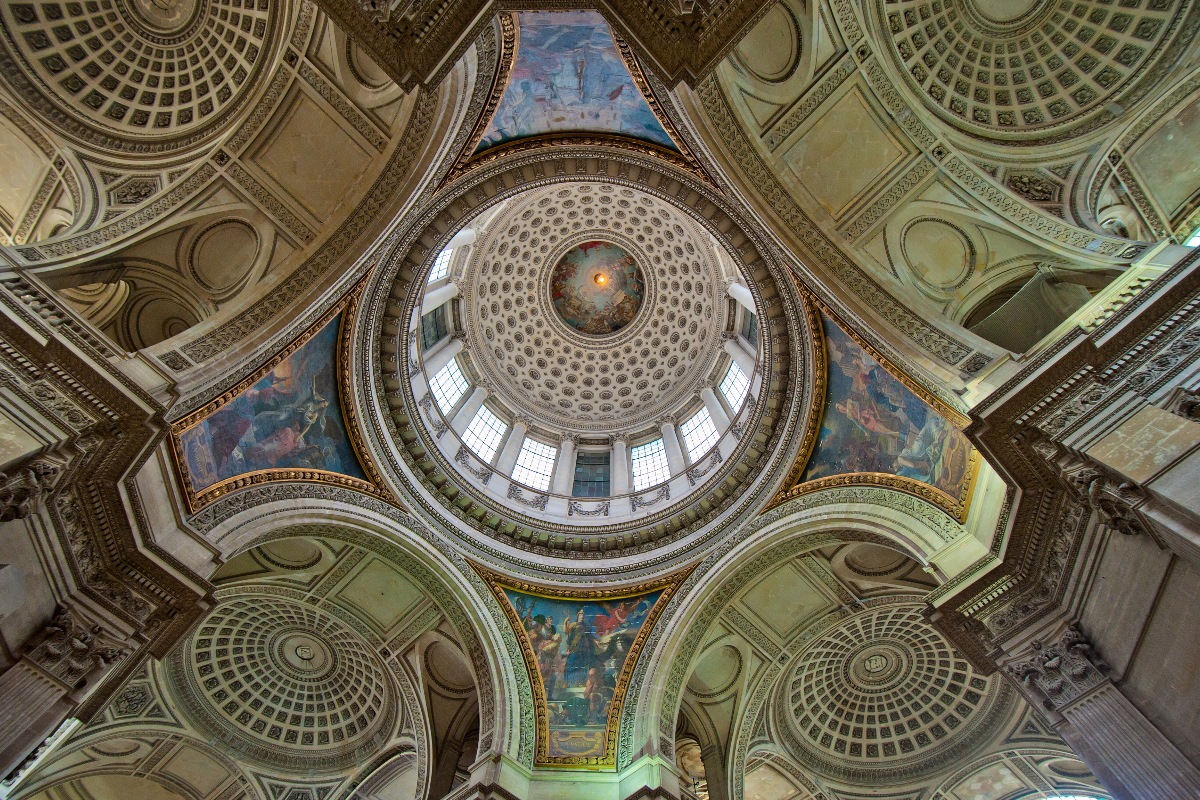
Louis XV promised God a church if he got over a bad fever. He did, and the building was finished just in time for the Revolution, which turned it into a tomb for the country’s heroes. Voltaire and Victor Hugo are in the crypt. So are Marie and Pierre Curie, and the American-born Josephine Baker was honored here in 2021. Under the dome hangs Foucault’s pendulum, which showed Paris in 1851 that the earth turns.
The Place de la Contrescarpe and rue Mouffetard
From the Panthéon, rue Descartes leads to a small square ringed with cafés. Ernest Hemingway and his wife Hadley rented a cold-water flat around the corner on rue du Cardinal-Lemoine in 1922. He later wrote that they were very poor and very happy. Rue Mouffetard runs downhill from the square along the line of an old Roman road. It has been a market street since the Middle Ages, with crêpes at the top and cheese, bread, fruit and fish at the bottom.
Getting around
The walk is about two miles, up to the Panthéon and down the other side. The student cafés around the Sorbonne and the Contrescarpe have the cheapest coffee and lunch in central Paris.
The Marché Monge, five minutes east of rue Mouffetard, is a neighborhood market and not a tourist one. Buy a picnic there and eat it in the Jardin des Plantes, ten minutes farther east. Market hours are on paris.fr.
When to go
Weekday mornings are best for the streets and the bookshops. Sunday morning is best for rue Mouffetard and the market, when the whole neighborhood is shopping for lunch.
From September to June the quarter is full of students and lives up to its name. August is quiet, and some shops close.
The Panthéon closes on January 1, May 1 and December 25. Shakespeare and Company is open every day.
Frequently Asked Questions
Why is it called the Latin Quarter?
The students and teachers of the Sorbonne and the colleges around it studied and spoke in Latin until the Revolution. The name stuck.
Is rue Mouffetard worth it?
Yes. Walk it downhill from the Place de la Contrescarpe on a weekend morning, when the food shops at the bottom are open and busy. In the evening the top of the street belongs to the student bars.
How long does the Latin Quarter take?
Half a day covers the walk. Add an hour for the Panthéon and an hour for the Cluny museum.
Latin Quarter or Saint-Germain?
Do both. Saint-Germain-des-Prés is next door to the west, with the cafés, the galleries and the Luxembourg Garden.
Is there a guided tour of the Latin Quarter?
Yes. Our Private Latin Quarter & Notre Dame Walking Tour is $560 for two people, plus $25 per person up to six. It meets by the Charlemagne statue in front of Notre-Dame, lasts two hours and runs every day. A pastry stop is part of it.
Our Most Popular Day Trips From Paris

Half a day on foot with a private guide, routed around what you want to see.