The short version
- Go to the two oval rooms first and sit down on the bench in each one. These paintings were made for sitting.
- Don’t skip the downstairs. It has Renoir, Cézanne, Matisse, Picasso and Modigliani, and most visitors rush it.
- Buy a timed ticket on the museum’s site. The oval rooms are quiet for the first half hour and full by 11:00 a.m.
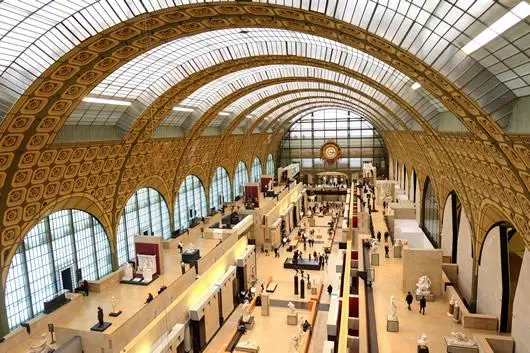
- See the Orsay’s Impressionists with a private guide!

What to see
A greenhouse for orange trees
The name means what it says. The building went up in 1852 to keep the orange trees of the Tuileries garden alive through the Paris winter. That is why one long side is glass and faces south over the river.
Monet’s gift
On November 12, 1918, the day after the guns stopped, Monet wrote to his friend Georges Clemenceau, the prime minister who had just won the war. He wanted to give France some paintings as a monument to peace. It took eight more years. Monet’s eyes clouded over with cataracts, he repainted, he threatened to back out, and Clemenceau kept after him.
Monet never let the canvases leave his studio in Giverny while he was alive. He died in December 1926, and the rooms opened a few months later.
The Water Lilies
Eight paintings wrap around two oval rooms, nearly 100 meters of pond from end to end. There is no horizon and no shore, only water, sky and willow branches. Monet wanted oval rooms and daylight from above, and he got both. The painter André Masson called the place the Sistine Chapel of Impressionism.
In the 1960s a new floor was built overhead and the daylight was shut out for forty years. A rebuild finished in 2006 gave the pond its sky back.
Paul Guillaume’s painters
Downstairs is the collection of Paul Guillaume, a young dealer who bet on painters almost nobody wanted. Modigliani painted his portrait in 1915 and wrote Novo Pilota on it, the new helmsman. The Renoirs, Cézannes, Matisses and Picassos on these walls came from him and his wife, Domenica.
Soutine’s lucky day
Chaïm Soutine was a penniless painter from a village in what is now Belarus. In the early 1920s the American collector Albert Barnes saw one of his pictures through Guillaume and bought dozens on the spot. Soutine went from hungry to famous in an afternoon. His twisting landscapes and red-faced portraits fill a room here.
The Douanier Rousseau
Henri Rousseau collected tolls at the Paris city gates, which is how he got the nickname the customs man. He taught himself to paint and was laughed at for most of his life. Picasso and his friends decided he was a master. Look for the stiff, wonderful wedding party staring straight at you.
Getting in
There is one way in. The museum sits in the Tuileries garden at the Place de la Concorde end, on the river side, a few minutes from the metro.
An online ticket gets you priority at the door for 30 minutes after the time printed on it. Last entry is 5:15 p.m., and the rooms close at 5:45. You can’t come back in once you leave, so see both floors first.
When to go
Be there for the 9:00 a.m. opening on a weekday. While an exhibition is on, the museum stays open until 9:00 p.m. on Fridays, and the ticket drops to €10 after 6:00.
The first Sunday of the month is free with a slot booked online, and it is the busiest day of the month. The museum is also closed on May 1, the morning of July 14 and December 25.
Frequently Asked Questions
Do I need a timed ticket for the Orangerie?
Get one. It gives you priority at the door within 30 minutes of your slot. Without it you stand in the general line, which is long on a weekend afternoon.
How long does the Orangerie take?
Plan about 90 minutes. That is 40 minutes in the two Water Lilies rooms and 45 downstairs, and a little more when an exhibition is on.
Can I see the Orangerie and the Orsay in one day?
Yes, Wednesday to Sunday, when both are open. A combined ticket is €20 at the ticket desk of either museum. The Musée d’Orsay is a 15-minute walk away, across the footbridge.
Is the Orangerie free?
It is free for everyone under 18 and for EEA residents under 26. It is also free for everyone on the first Sunday of the month, with a slot booked online.
Is there a guided tour of the Impressionists?
Yes, across the river. Our Private Musée d’Orsay Tour is $725 for two people, plus $70 for each additional person up to six, with timed tickets included. It lasts two hours and runs daily except Sundays and Mondays, which leaves the Orangerie for your afternoon.
Our Most Popular Day Trips From Paris

Half a day on foot with a private guide, routed around what you want to see.