The short version
- The Luberon is a limestone ridge 60 kilometers long between Cavaillon and Manosque, split in two by the Combe de Lourmarin, with the villages of Peter Mayle’s A Year in Provence hung along its north face and a regional park of 185,000 hectares around it. Gordes, Roussillon, Ménerbes and Lourmarin are all on the Plus Beaux Villages list; the Cistercian abbey of Sénanque sits in a fold below Gordes with lavender in front of it from mid-June to mid-July.
- Our Best of Provence in Three Days meets your train at Avignon TGV and spends its second day in a van of eight at most on Roussillon, Gordes, Fontaine-de-Vaucluse, Saint-Rémy, the Pont du Gard and Les Baux, admissions and dinner in, with two nights in Avignon, $1,925 per person. Our Two-Night Biking in Provence rides Avignon on e-bikes, sleeps two nights in Gordes, does Roussillon, Lacoste and Ménerbes on the second day with a wine tasting, and finishes with the Fontaine-de-Vaucluse to L’Isle-sur-la-Sorgue loop, $1,185 per person, eight guests at most, February to mid-December.
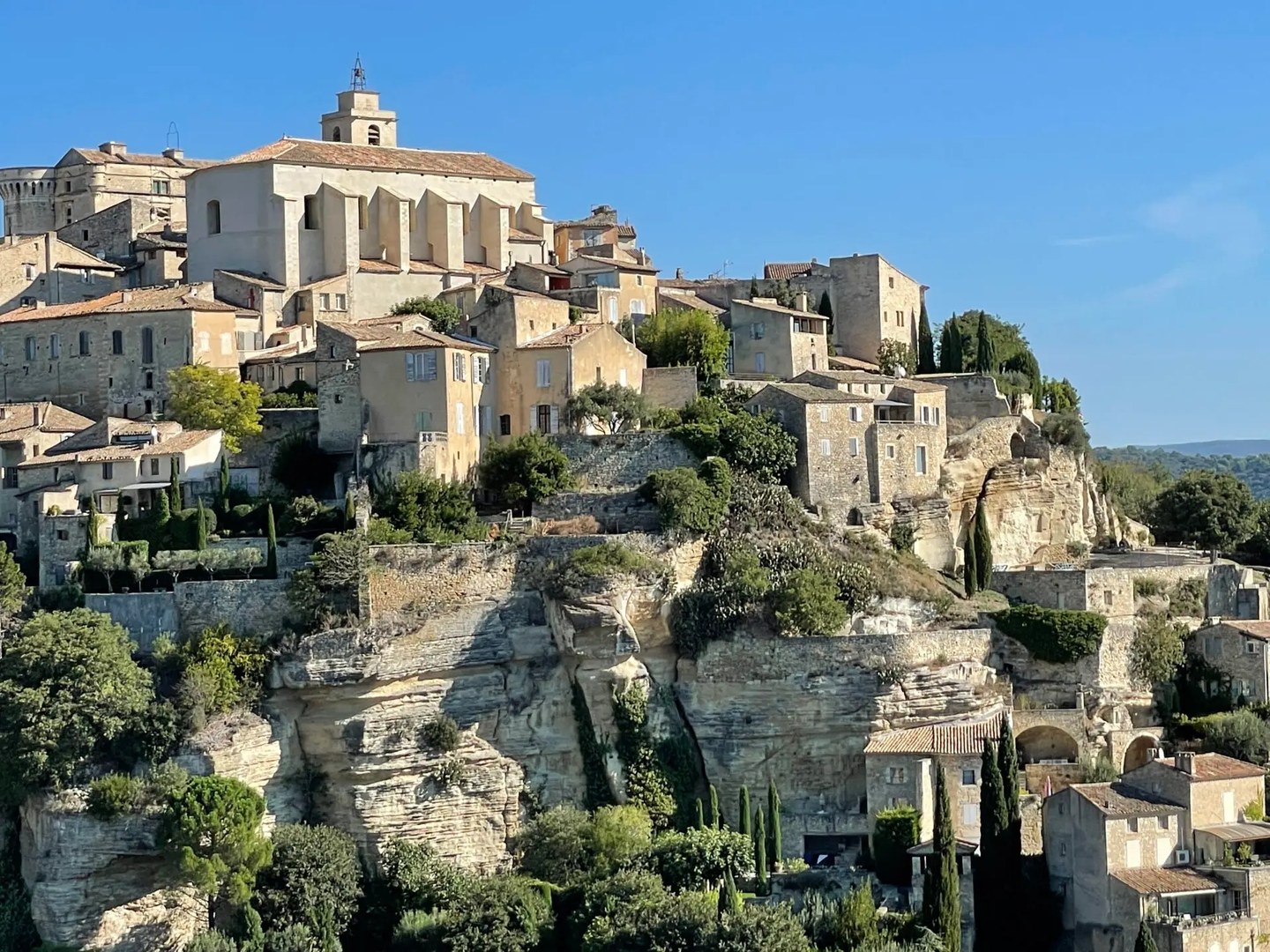
- Gordes is the village on the cliff, 373 meters up, with the château of 1525 on the square, €6, the Tuesday market from 8:00 to 13:00, and the Village des Bories four kilometers out, the biggest group of the dry-stone huts the shepherds built, €8 and open every day. Sénanque, founded in 1148 and still a working monastery, is three kilometers down a one-way lane: €8 on a guided tour in French or with a tablet in eleven languages, no visits on Sunday mornings, no walking into the lavender, and no bus.
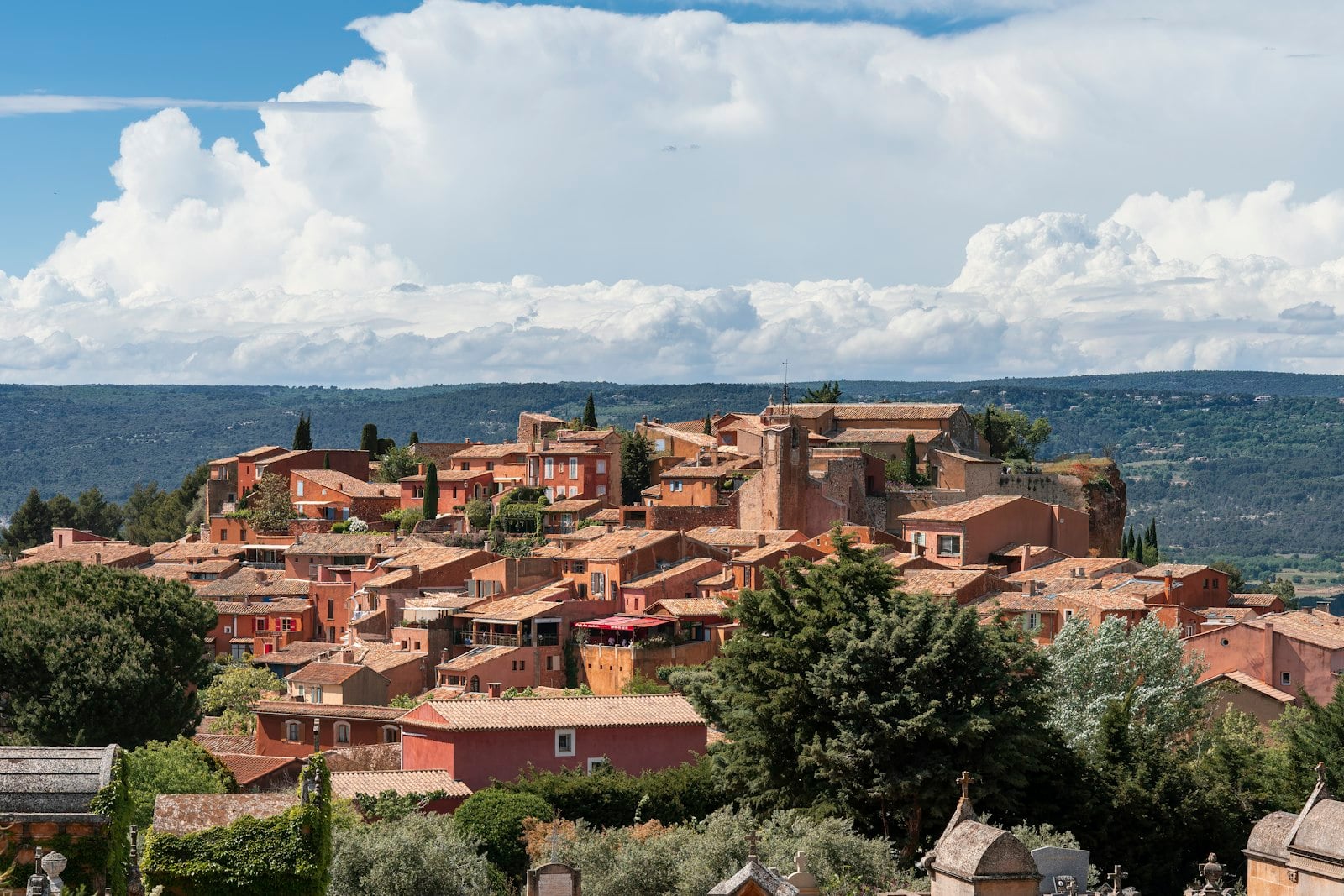
- Roussillon is built of the ochre it dug for three centuries, and the Sentier des Ocres walks you through the old quarry in 30 or 50 minutes for €3.50, open from February to the end of December. The Colorado Provençal at Rustrel, past Apt, is the bigger version, with a 40-minute family loop and a two-hour one over the chimneys, charged by the car, €8 in summer, closed from mid-November to early February and booked by the morning from May to August.
- The south side is quieter: Bonnieux on its crest with the Friday market and 86 steps up to the old church, the Roman Pont Julien of 3 BC three kilometers below it, Lacoste with the Marquis de Sade’s castle that Pierre Cardin rebuilt, open in July and August, Ménerbes with the Maison de la Truffe et du Vin and its 170 Luberon wines, Oppède-le-Vieux ten minutes on foot above its car park, and Lourmarin through the combe, with the first Renaissance château in Provence, €8, and Camus in the cemetery.
- Without a car the Luberon is a Monday-to-Saturday place: the Zou 915 bus from Avignon TGV and the 907 from Avignon Centre reach Coustellet, where the 917 goes on to Gordes and Roussillon four times a day and the 918 to Oppède, Ménerbes, Lacoste and Bonnieux twice, out at 8:00 and back at 17:40; none of them runs on Sundays or holidays, and nothing goes to Sénanque, the Colorado or Lourmarin. L’Isle-sur-la-Sorgue is the exception, on the train from Avignon, with a bus to the spring in 12 minutes.

What to see
Start with the three our day covers. Roussillon at nine, before the car parks fill, for the ochre trail and the view from the top of the village over the red cliff to the ridge; Gordes next, where the picture is from the Rocher Bel-Air on the road in and the village itself is the château, the lanes and the terraces below it, then the Bories if you have the hour; and Fontaine-de-Vaucluse, where the Sorgue comes out of the foot of a 230-meter cliff at the end of a 15-minute walk, the biggest spring in France, highest from January to May and at its best in March, when it boils green over the rocks, and a trickle at the bottom of the pit in September. The last 50 meters to the pit are closed for rockfall, with the view from just before the barrier. Vallis Clausa makes paper by hand on the walk, and the Pétrarque museum on the left bank, €7 from April to September, remembers the poet who lived here for Laura.
Sénanque is the Luberon’s postcard and a monastery first: the church, cloister, chapter house and dormitory of the 12th century are seen on the hour-long guided tour, 10:30, 14:00 and 15:30 from Monday to Saturday in winter and afternoons only on Sunday, or at your own pace with the tablet; dress for a church, keep quiet, and photograph the lavender from the road, because the field is the monks’ crop and closed to walkers. The abbey is three kilometers from Gordes by the D177, one-way downhill from March 15 to September 30, with a free car park five minutes from the door; on foot it is half an hour down and an hour back up. Mid-June to mid-July is the bloom, and the first week of July the safest bet.
Then the villages the vans skip, which is what the biking trip is for. Bonnieux stacks up the north face of the Petit Luberon to a 12th-century church, with the cedar forest a kilometer above and the Pont Julien below, three arches that have carried the Via Domitia since Augustus and now carry the Calavon greenway, 45 flat kilometers of old railway for bicycles. Lacoste, across the valley, is the Marquis de Sade’s ruin, bought and half rebuilt by Pierre Cardin in 2001 and open only in July and August, €8, with an American art school in the lanes below it. Ménerbes is Mayle’s village and Dora Maar’s, whose house opens on Tuesdays and Saturdays, €10; the Maison de la Truffe et du Vin on the square pours the Luberon appellation and sells the truffle in winter. Oppède-le-Vieux is the one the people left, a church on a spur above a ruined castle under restoration, ten minutes up from the Sainte-Cécile car park.
Lourmarin is the other side of the mountain, through the Combe de Lourmarin on the D943: the château, 15th-century on one wing and Renaissance on the other, open every day of the year, the Friday market under the plane trees, and the graves of Camus and Henri Bosco. L’Isle-sur-la-Sorgue, back on the plain, is the antiques town, 250 dealers in six villages of shops open from Friday to Monday, the Sunday brocante along the avenue des Quatre Otages and the Sunday market in the centre from 8:00 to 13:00, with the big fairs at Easter and in the middle of August, and the moss-covered waterwheels still turning on the branches of the river; our biking trip ends its last ride here. The Musée de la Lavande at Coustellet, on the road between, explains the still and the crop from the end of March to December 23.
The table is the plateau’s: Cavaillon melon from June, the black truffle from November to March, sold at the Ménerbes market in late December, goat cheeses with Banon in its chestnut leaf from the hills to the north, olive oil from the mills around the villages, candied fruit from Apt, lavender honey and the nougat of Sault, and the AOC Luberon, an appellation of 1988 in red, white and rosé from 73 estates, poured at Ménerbes and in every village bar. The markets make the week: Cavaillon on Monday, Gordes on Tuesday, Lacoste on Wednesday in season, Roussillon, Ménerbes and L’Isle on Thursday, Bonnieux and Lourmarin on Friday, Apt on Saturday, the biggest of them, and L’Isle-sur-la-Sorgue and Coustellet on Sunday.
Getting there and around
From Paris the Luberon is the TGV to Avignon, 2 hours 40 to 3 hours from Gare de Lyon, and a car or our van from there. Driving, take the A7 to exit 25 at Cavaillon, then the D900 east: Gordes is 25 to 30 minutes from Cavaillon and about 45 from Avignon, Ménerbes 40 minutes from Avignon, Lourmarin 50. The villages are 10 to 20 minutes apart on hill roads, and the full circuit, Gordes, Roussillon, Bonnieux, Lacoste, Ménerbes, is a day with no spare time for Sénanque or the spring.
Parking is the tax. Gordes has six paid car parks at the village edge, €8 for up to four hours and €10 for the day, full by late morning in summer; Roussillon charges by the quarter hour and closes the square to cars on Thursday mornings; Ménerbes is free at the entrance, Oppède-le-Vieux paid below the village, Sénanque free. Coaches cannot enter Gordes at all, and the D177 down to the abbey is one way from mid-March to the end of September.
The buses are honest but thin. From Avignon TGV the 915 runs to Coustellet, Bonnieux-gare on the valley road and Apt about 18 times on a weekday; from Avignon Centre the 907 goes to Cavaillon and Coustellet. At Coustellet the 917 climbs to Gordes and Roussillon four times a day from Monday to Saturday, the first at 8:00 and the last back from Roussillon at 18:15, and the 918 does Oppède, Ménerbes, Lacoste and Bonnieux twice, 8:00 out and 17:40 back. Nothing runs on Sundays or public holidays into any hill village, nothing serves Sénanque, the Colorado or Lourmarin, and the taxis publish no fares. The train from Avignon Centre reaches L’Isle-sur-la-Sorgue and Cavaillon in about half an hour, with the 914 bus from L’Isle to the spring in 12 minutes on weekdays and Saturdays; the line was under works in autumn 2026, with some midday runs taking twice as long. Check the Zou planner the night before.
By bicycle the Luberon is a destination in its own right: the V863 loop of 240 kilometers around the massif in six days, the Calavon greenway for families, and 230 Accueil Vélo rental shops, hotels and bike-friendly stops. That is the logic of our Two-Night Biking trip: e-bike, helmet and admissions included, a guide who knows the back roads between Roussillon, Lacoste and Ménerbes, and the van for the transfers from Avignon to Gordes and down to the Sorgue. The Six Days runs the same van day as the Three Days and goes on to Nice; the Five Days gives the Luberon a private day with a wine tasting and an optional truffle lunch; the Lavender Tour, July 6 to 25, adds Sault and Sénanque to Gordes.
When to go
This is Mediterranean hill country: hot, dry summers that push past 30 degrees on the ochre, most of the rain in autumn and spring, and the mistral, the cold north wind that clears the sky and shakes the shutters for days at a time. The spring at Fontaine-de-Vaucluse runs highest from January to May; the ochre trails and the Colorado close on red fire-risk days in summer, when the Vaucluse map goes out at 18:00 for the next morning.
Lavender is mid-June to mid-July at Sénanque and on the Claparèdes plateau above Bonnieux, a little later up at Sault; by the end of July it is cut. The first half of July is the safe week, and it is also the busiest the villages get. June and July are when our Three Days puts the fields in the second day, and the Lavender Tour runs July 6 to 25 only.
From November to February the Colorado is closed, the Sentier des Ocres runs 11:00 to 15:30 and shuts on public holidays, the ochre works at Roussillon open afternoons only, the Lavender museum closes from Christmas Eve to the end of March, the Pétrarque museum from October to April, and the seasonal markets at Lacoste and Ménerbes stop; the Lourmarin château, the Bories, the Gordes château and Sénanque stay open, and Gordes gains a Saturday producers’ market from December to March. Our biking trip pauses from mid-December to the end of January.
The year turns on the L’Isle-sur-la-Sorgue antiques fairs at Easter and in the middle of August, Cavaillon’s melon festival in early July, the Lourmarin Wine and Dine evening in mid-July, the Lacoste festival in Pierre Cardin’s quarry in July, and the Ménerbes truffle market on a Sunday in late December. April to June and September to October are the months for the villages themselves, with the markets full and the car parks not.
Frequently Asked Questions
Is the Luberon a day trip from Avignon?
The big three are: Roussillon, Gordes and Fontaine-de-Vaucluse are 40 minutes from Avignon by road and that is the morning of our Provence day, with Saint-Rémy, the Pont du Gard and Les Baux in the afternoon. Bonnieux, Lacoste, Ménerbes and Lourmarin want a second day, which is why our biking trip sleeps in Gordes.
Can I see the Luberon on my own, without a car?
Monday to Saturday, with planning: bus to Coustellet from Avignon, then the 917 to Gordes and Roussillon, four runs a day, or the 918 to Ménerbes and Bonnieux, two runs, and the train and bus for L’Isle-sur-la-Sorgue and the spring. What you give up is Sénanque, which no bus reaches, Sundays altogether, and the stops between the villages, the Bories, the Pont Julien, the view from the Claparèdes, which is where a van with eight people and a guide, or an e-bike with one, earns its keep.
When is the lavender in bloom at Sénanque?
Mid-June to mid-July as a rule, with the first ten days of July the safest; the harvest follows and the field is bare by the end of the month. The field belongs to the monks and is closed to walkers, so the photograph is from the road above. Our Lavender Tour, July 6 to 25, goes to Sault and Sénanque on the same day; the Three Days and Five Days put the fields in their Luberon day in June and July.
Which village should I stay in?
Gordes for the view and Sénanque on foot, which is where our biking trip puts you for two nights; L’Isle-sur-la-Sorgue for the train, the Sunday brocante and the river; Lourmarin for the south side and the road on to Aix; Avignon for everything else, with the villages 40 minutes away, which is how our other Provence tours work.
Is there a tour from Paris?
Yes, two. Our Best of Provence in Three Days, $1,925 per person, meets you at Avignon TGV and gives the Luberon the morning of its second day with Roussillon, Gordes and Fontaine-de-Vaucluse; our Two-Night Biking in Provence, $1,185 per person, sleeps in Gordes and rides Roussillon, Lacoste, Ménerbes and the Sorgue on e-bikes, February to mid-December. Rail from Paris is not included on either and we book it once your dates are set.
Our Most Popular Day Trips From Paris


Ride between Avignon and the Provence villages with two hotel nights along the way.


