
The short version
- The landing beaches run about 80 kilometers along the coast west of Caen, from Sword at Ouistreham to Utah on the Cotentin. The American sites, Omaha Beach, the cemetery at Colleville and Pointe du Hoc, are on the western half, and Arromanches with its artificial harbor is just east of them.
- Our Normandy D-Day Tour meets you on the platform at Bayeux station and covers Sainte-Mère-Église, Utah Beach, Omaha Beach, Pointe du Hoc, Arromanches and the American Cemetery in one day, eight guests at most, $230 per person or $352 with the train.
- The sites are all within 45 minutes of Bayeux by road, in different directions. Outside the summer line we found no bus that reaches the cemetery, Omaha or Pointe du Hoc, so the day needs a car or a guide.
- The Normandy American Cemetery is free, open every day from 9:00 to 17:00, with a flag-lowering ceremony an hour before closing. Pointe du Hoc is free too, and stays open through a restoration that runs to mid-2027.
- The museums charge: Utah Beach €10, the Airborne Museum in Sainte-Mère-Église €11.50, Arromanches €12.90, the Mémorial de Caen €20.80. Several close for part of the winter.
- The beaches joined the UNESCO World Heritage List in July 2026. The Bayeux Tapestry is on loan in London until July 2027, and its museum is closed until autumn 2027.

What to see
Sainte-Mère-Église is the first stop, the town the paratroopers dropped into in the early hours of June 6. A dummy paratrooper still hangs from the church tower, and the Airborne Museum next to it covers the 82nd and 101st in about two hours, €11.50. It closes in December and January except over the Christmas holidays.
Utah Beach, the western landing beach, has its museum right on the sand, built around a B-26 bomber, €10, tickets online only. It closes from November 16 to December 14.
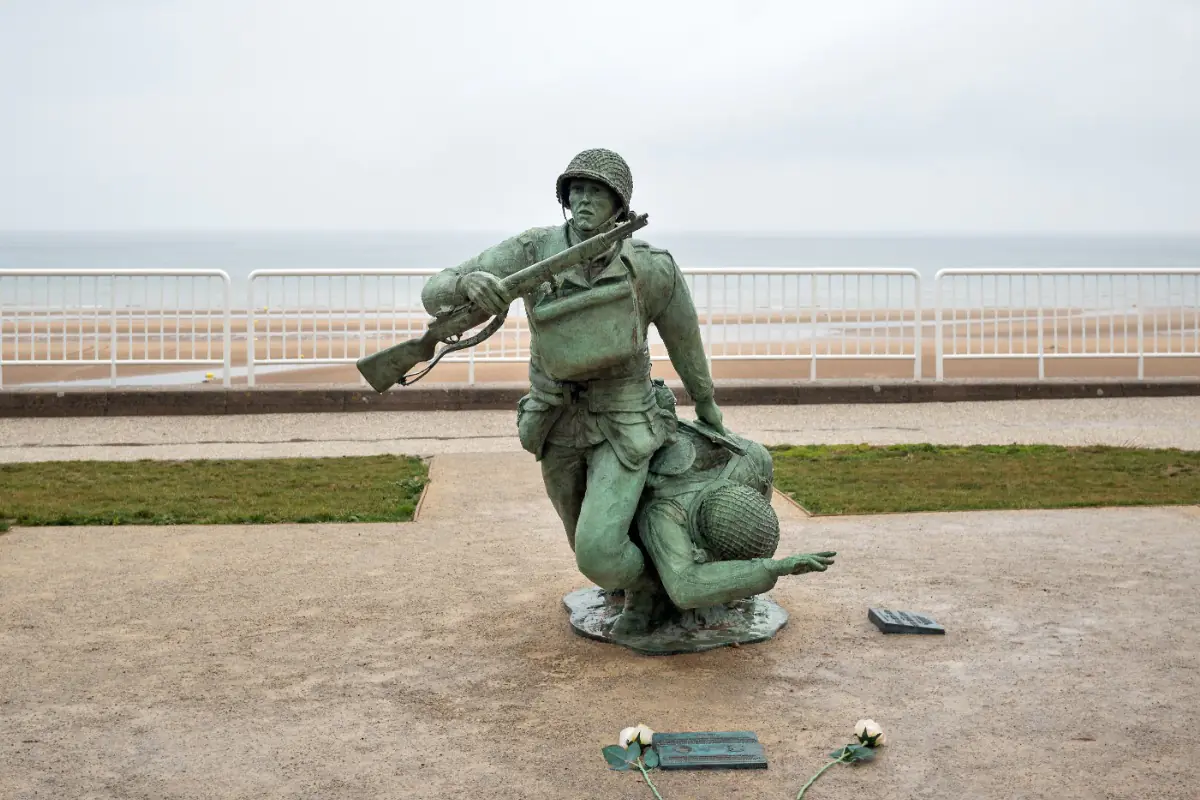
Omaha Beach is the long open beach below the bluffs at Saint-Laurent and Colleville, with the steel sculpture Les Braves standing on the sand. The bluffs and the draws the troops fought up are all still there to see.
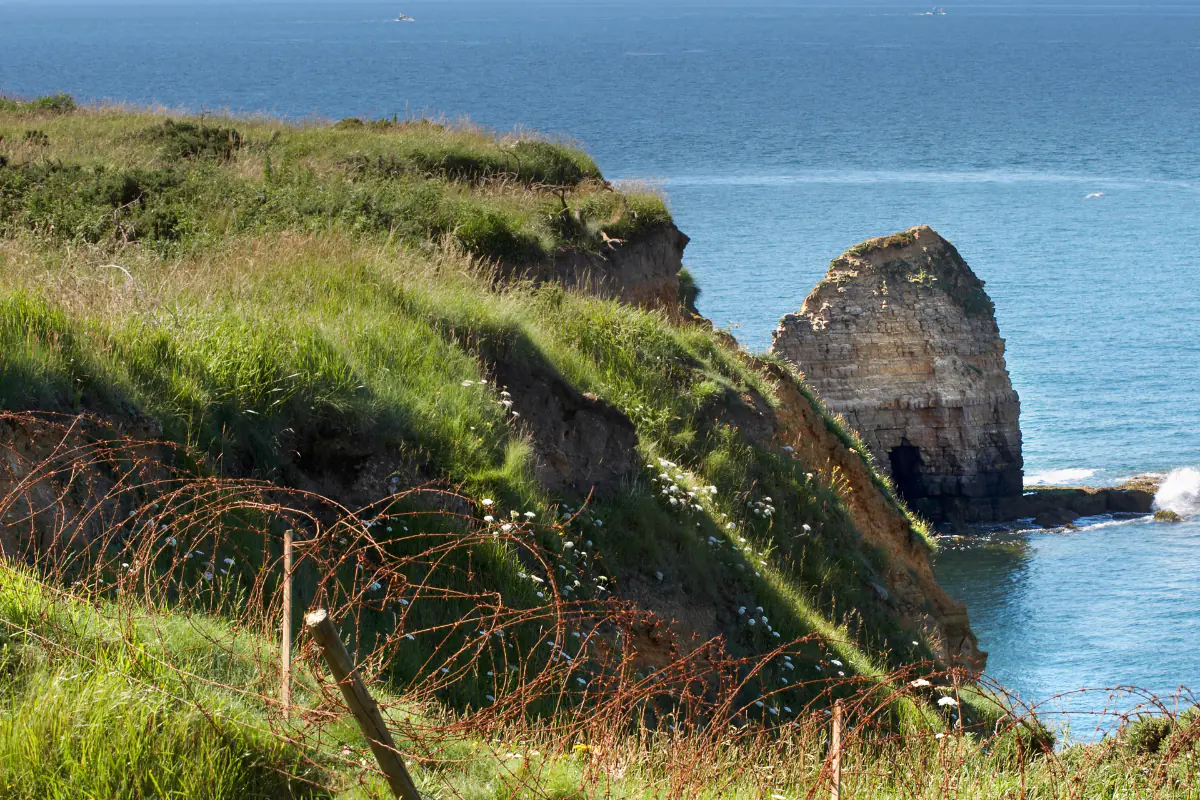
Pointe du Hoc is the cliff the Rangers climbed, still pocked with shell craters and bunkers. It is open every day, and under restoration until mid-2027: the visitor center is closed, the film plays outdoors, and you walk the site along the west path.
At Arromanches the concrete sections of the Mulberry harbor still stand offshore and on the sand, there to see all year. The Musée du Débarquement on the seafront explains how the harbor was built, €12.90, about 90 minutes. The German battery at Longues-sur-Mer, between here and Omaha, is the only one with its guns still in place.
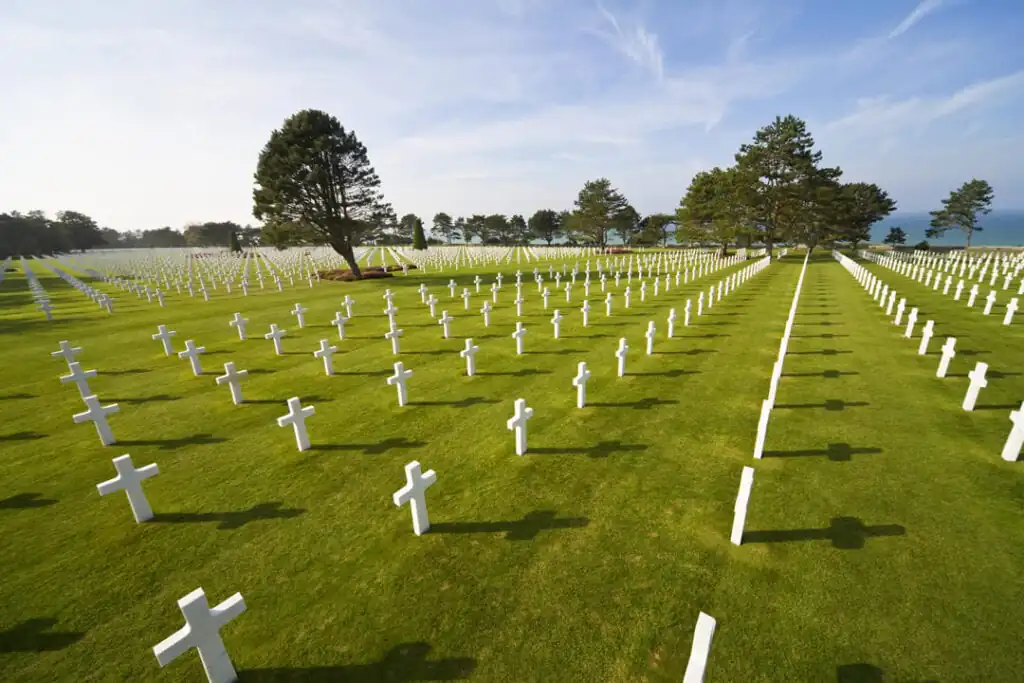
The Normandy American Cemetery at Colleville-sur-Mer holds 9,389 graves and 1,557 names on the Wall of the Missing, on the bluff above Omaha. It is open 9:00 to 17:00 every day except December 25 and January 1, with free guided tours in English at 11:00 and 14:00 from April to September and at 14:00 the rest of the year. The flag comes down an hour before closing. Our tour ends here.
Getting there and around
Regional trains run direct from Paris Saint-Lazare to Bayeux, 2 hours 12 minutes at the fastest, 13 a day, from €17. Caen is 1 hour 54. Bayeux station is in town, a 10 to 15 minute walk from the museums.
From Bayeux, the beaches are 15 to 45 minutes away by road. In July and August a summer bus runs from the station to the American Cemetery three times a day, about 40 minutes each way. The rest of the year the only bus toward the coast goes to Arromanches, Monday to Saturday, and we found no bus to Utah or Sainte-Mère-Église in any season. Taxis at the station run on the meter, with no fixed fares.
This is why the tour meets the train. Our guide is on the platform at about 8:40 a.m., the van does the full loop with a lunch stop on the coast, and you are on the evening train back, in Paris around 9 p.m. The weekend morning train arrives later, so weekend dates run as private tours.
If you would rather not take the train, our private D-Day tour picks you up at your Paris hotel at 7:00 a.m. and brings you back by 8:00 p.m., $2,425 for up to six people. Already in Normandy? The same small-group day leaves Bayeux station at 9:00 a.m.
When to go
April to September is the full season: the cemetery runs two guided tours a day, the museums stay open until 18:30 or 19:00, and the light lasts. July averages a high of about 23°C.
The D-Day Festival fills the first half of June with parades, parachute drops and ceremonies along the coast. We don’t run the tour on June 6 itself, and that week books up early.
It rains on 12 to 14 days a month from October to January, and the wind on the bluffs is steady all year. Bring a layer and shoes for grass and sand.
The sites themselves stay open all winter, so the tour runs year-round except major holidays. The museums thin out: Utah Beach closes from November 16 to December 14, the Airborne Museum for December and January, and the Juno Beach Centre for all of January.
Frequently Asked Questions
How do you get from Paris to the D-Day beaches?
Take the direct regional train from Paris Saint-Lazare to Bayeux, 2 hours 12 minutes at the fastest, from €17. From Bayeux the sites are all within 45 minutes by road in different directions, so the day needs a car or a guide. Our tour meets the morning train on the platform.
Can I do the D-Day beaches on my own?
With a rental car, yes: the cemetery and Pointe du Hoc are free and need no booking, and the museums sell tickets at the door or online. Without a car it is hard: outside July and August no bus from Bayeux reaches the cemetery, Omaha or Pointe du Hoc, and taxis run on the meter. What you give up either way is the guide, who knows what happened at the spot where you are standing, and the order to see it all in.
Which tour should I pick?
The Normandy D-Day Tour is the beaches: six sites from Sainte-Mère-Église to the American Cemetery, meeting at Bayeux. The Caen Memorial tour starts with a guided visit of the museum and lunch there, then Omaha, Pointe du Hoc and the cemetery, meeting at Caen station. Canadians have a Juno sector tour on Tuesdays from April to October. To add Mont-Saint-Michel, take the overnight, with a night in Bayeux.
Is Pointe du Hoc open during the restoration?
Yes. The site is open every day and free. Until about mid-2027 the visitor center is closed, the film is shown outdoors, you walk in along the west path, and parking is limited. The craters, bunkers and the view from the cliff are all there.
Is there a tour from Paris?
Yes. Our Normandy D-Day Tour takes the early train from Saint-Lazare, meets you on the platform at Bayeux, and covers six sites with a lunch stop on the coast, 13 hours door to door. It is $230 per person, $352 with second-class rail or $445 with first, eight guests at most, every day except major holidays and June 6. Weekends run as private tours.
Our Most Popular Day Trips From Paris
Your own expert driver-guide for the entire day. Flexible routing for up to 6 people.
See the D-Day beaches and Mont Saint Michel. Overnight in charming Bayeux.
Guided tour of the Caen Memorial museum plus the D-Day beaches. Lunch included.

Mont St. Michel, Omaha Beach and the American Cemetery packed into one long day.
