
The short version
- Plan on a car or a guide. The battlefield is ten minutes outside the town, and no bus goes there.
- Bring a sweater, even in August. The forts stay cold inside all year.
- Avoid January, when the Mémorial, the forts and the ossuary are closed.
- Our private guide meets your train in Reims.

The battlefield
On February 21, 1916, the German army opened fire on the hills above Verdun with more than a thousand guns. The fighting went on until December. About 300,000 men died, French and German, and the front line ended the year close to where it began.
A forest was planted over the battlefield after the war. Under the trees the ground is still all craters.
Fort de Douaumont
This was the biggest fort around Verdun. Four days into the battle it fell to a handful of German soldiers who climbed in and met almost no one. The French army had stripped its garrison months earlier. Taking it back cost eight months and tens of thousands of lives. Inside, a wall closes off a gallery where hundreds of German soldiers died in an explosion in May 1916. They are buried behind it.
Fort de Vaux
In June 1916 Major Raynal and his men held this smaller fort for a week, fighting in the dark corridors, with no water left. Their last message went out by carrier pigeon. The bird got through and was cited for bravery. When Raynal finally surrendered, the German crown prince was so impressed that he handed him a sword.
The Douaumont Ossuary
After the war the bones of about 130,000 unknown soldiers, French and German together, were gathered from the fields and laid under this long stone building. In front of it are 16,142 French graves. In 1984 President Mitterrand of France and Chancellor Kohl of Germany stood here and held hands.
The lost villages
Nine villages around Verdun were destroyed so completely that they were never rebuilt. Fleury changed hands sixteen times in one summer. France declared that the nine had died for their country. Each still has a mayor, a chapel and markers showing where the streets ran.
The town and the Sacred Way
One road kept Verdun alive. Trucks ran along it from Bar-le-Duc day and night, and the French named it the Voie Sacrée, the Sacred Way. Three-quarters of the French army took a turn in the battle.
Under the town, the Citadelle was a city of bakeries and bunks. In 1920 a young soldier there laid a bunch of flowers on one of eight coffins. That man is the Unknown Soldier who lies under the Arc de Triomphe.
The Western Front nearby
The Butte de Vauquois
A village of 168 people once stood on this hilltop. The two armies dug in on either side and spent years tunneling under each other and setting off mines. The village is gone. In its place is a row of craters, some of them 60 feet deep.
Varennes and the Americans
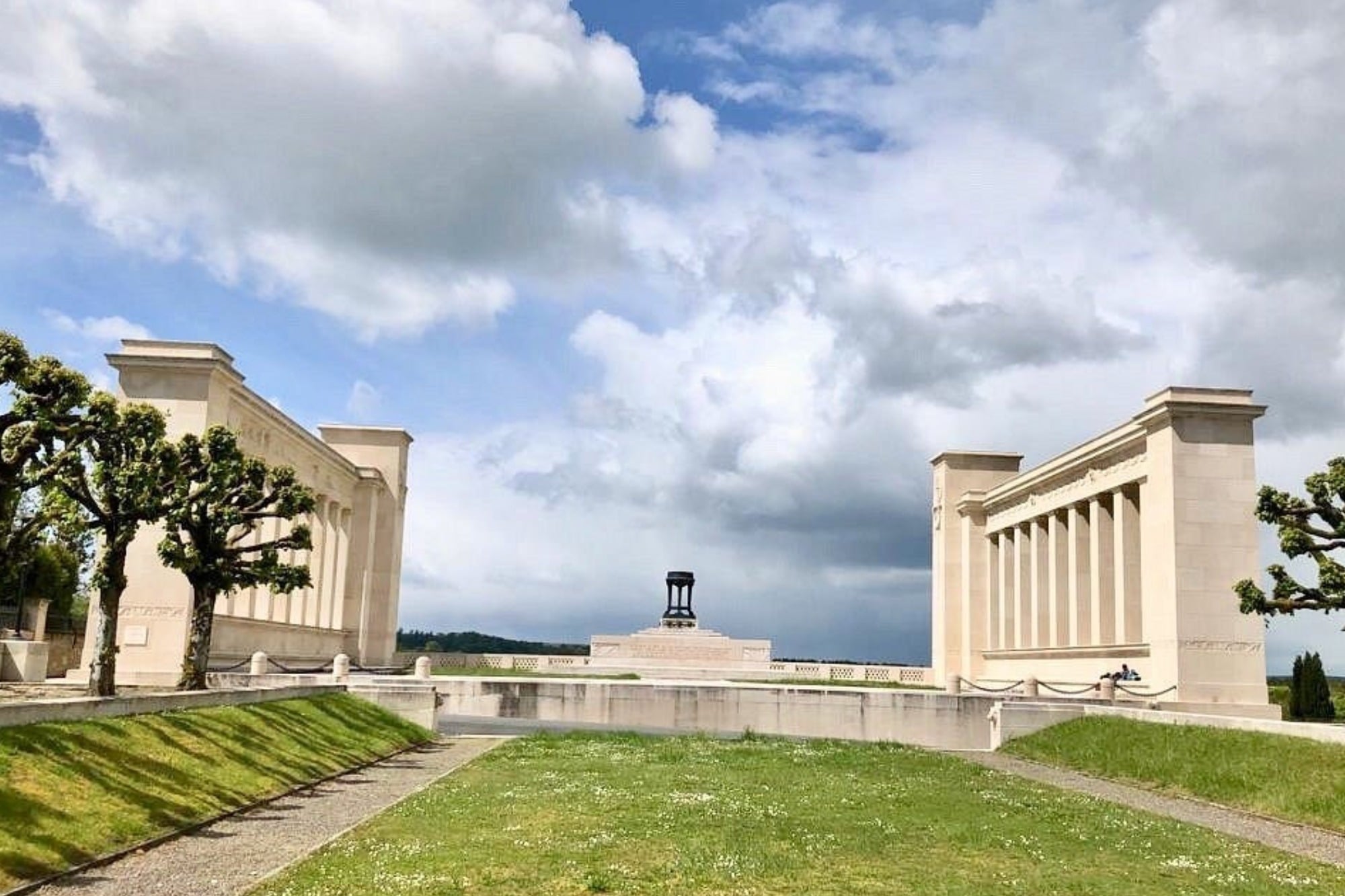
Varennes was already famous. In 1791 Louis XVI and Marie Antoinette were caught here while trying to flee France in disguise. In September 1918 the American army came through in the Meuse-Argonne offensive, with more than a million men under General Pershing. The Pennsylvania Memorial stands in the town.
The Meuse-Argonne American Cemetery in Romagne holds 14,246 graves. It is the largest American military cemetery in Europe, larger than the one in Normandy.
Navarin
Between Reims and Verdun, on the old Champagne front, a stone pyramid stands in open fields. Three soldiers charge across the top, and the ossuary below holds men of several nations who were never identified.
Getting there
From Paris Est the TGV reaches Meuse TGV station in an hour, and a coach on the same ticket takes 30 minutes more into Verdun. By road, Verdun is 1 hour 15 minutes from Reims.
When to go
April to June and September to October are the best months. The ground is dry enough to walk, and the sites stay open late.
For something sweet to take home, Verdun has made dragées, sugared almonds, since the Middle Ages.
Frequently Asked Questions
Is Verdun a day trip from Paris?
Yes, but it is a long one. By train and coach it takes 1 hour 40 minutes each way at best, and the battlefield is outside the town.
What is the difference between the Mémorial, the ossuary and the forts?
The Mémorial de Verdun is the museum, and it explains the battle in about an hour and a half. The ossuary is the tomb. The forts are what the two armies fought over.
Is the Douaumont Ossuary free?
The cloister, the chapel and the cemetery are free. The film and the climb up the tower cost €7.
Can I visit the Meuse-Argonne American Cemetery?
Yes. It is free and open every day except December 25 and January 1. It is 26 miles northwest of Verdun.
Is there a Verdun tour from Paris?
Yes. Our Verdun and WWI Tour is a private day with a driver-guide who meets you in Reims. It visits Navarin, Vauquois, the Pennsylvania Memorial, the American cemetery and Fort de Douaumont. It costs $1,835 for two people, plus $185 per person up to six, with first-class rail from Paris. It runs daily from March to November.
Our Most Popular Day Trips From Paris

Normandy and the Battle of the Bulge across six days with a private van and guide.

Your own expert driver-guide for the entire day. Flexible routing for up to 6 people.