The short version
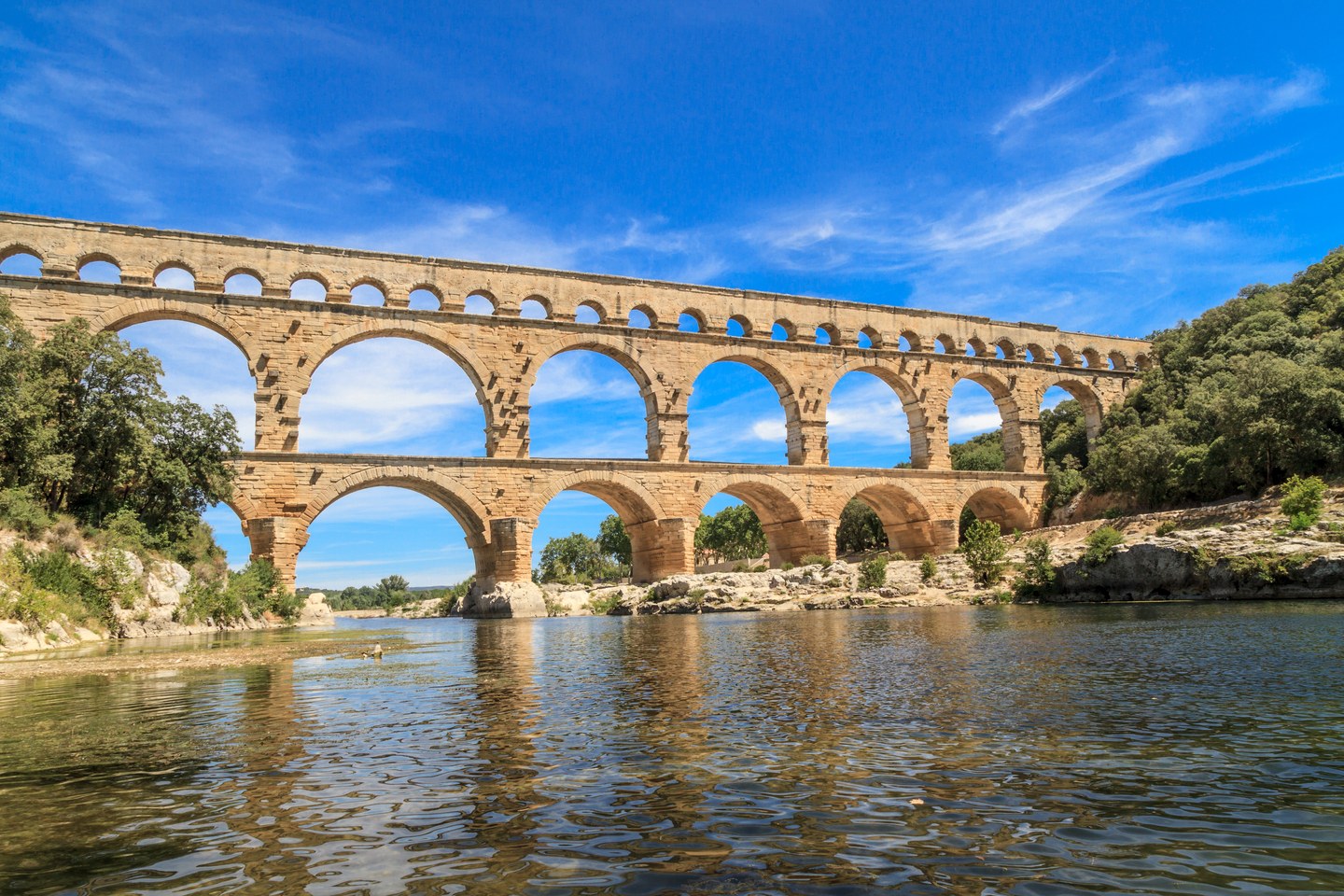
- The Pont du Gard is the tallest bridge the Romans left standing, 48.77 meters of three tiers built around 50 AD to carry the water of the Eure spring at Uzès 50 kilometers to Nîmes, a World Heritage site since 1985. The site is open every day of the year from 8:00 to midnight and is free; you pay for parking, €9 a car, the museum on the left bank, €8, and the guided climb to the water channel on top, €15, the only way up.
- Our Best of Provence in Three Days meets your train at Avignon TGV and gives the bridge its place on the second day: Roussillon, Gordes, Fontaine-de-Vaucluse, Saint-Rémy, the Pont du Gard and Les Baux between 8:30 and 7:00 p.m. with a guide and eight guests at most, dinner and admissions in, two nights in a four-star hotel inside the walls of Avignon and the Châteauneuf cellars on the last morning, $1,925 per person, daily, rail not included.
- Nîmes is a Roman city with a Spanish streak: the Arènes, the best-preserved amphitheatre anywhere, is €11 and open every day, 9:30 to 17:00 in winter and 8:00 to 21:00 in July and August; the Maison Carrée, the one complete temple of the ancient world, joined the World Heritage list in 2023; and the Pass Romanité, €20.50 for three days, covers both, the Tour Magne and the Musée de la Romanité across the boulevard, which shows Roman art lent by the Louvre until January 10, 2027 and closes on Tuesdays.
- Uzès, 25 kilometers north of Nîmes, is the market town: the arcaded Place aux Herbes fills with some 200 stalls on Saturday from 7:30 to 13:00 and with 60 producers on Wednesday morning, the Duché, the castle of the first dukes of France and still their house, is visited on a guided tour from €24 with tickets sold only at the door, and the round Tour Fenestrelle, the only Romanesque bell tower of its kind in France, stands by the cathedral. Haribo’s candy museum on the Nîmes road is €12 and closed on Mondays outside the school holidays.
- Paris Gare de Lyon to Nîmes is 21 trains a day, 14 direct, the fastest 2 hours 49, most about three hours, the last direct train home at 20:19. Nîmes has two stations, and the TGV one called Nîmes Pont-du-Gard is at Manduel, 12 kilometers out of town and 27 from the bridge; Nîmes Centre puts you eight minutes from the arena on foot. Avignon Centre to Nîmes is a 34-to-42-minute TER, 17 a day.
- The buses are the liO coaches at €2 a ride: the 115 from the Avignon bus station to the Pont du Gard stop in 37 minutes and on to Uzès in 18 more, six runs a day on weekdays; the 121 from Nîmes to the bridge in 43 minutes; the 152 from Nîmes to Uzès in 45. The stop for the bridge is a roundabout in Vers-Pont-du-Gard about a kilometer from the gate, and Sunday service on all three lines is a run or two a day.

What to see
Stand on the bridge first. The lower road deck is open and free and carries you across the Gardon between the two banks; the water channel along the top, 1.8 meters high and still lined with the Romans’ mortar, is reached only on the guided tour, about 80 steps up, €15 with the museum thrown in, booked online because the places are few. The museum, cinema and children’s area on the left bank are open from March to October, 9:00 to 18:00 in the shoulder months and to 20:00 in summer, and closed from November to the end of February; the bridge and the banks stay open all year from 8:00 to midnight. The right bank has the beach, the river paths and the restaurant Les Terrasses facing the arches; the left bank has the shop, the bistro and the Garrigue trail, a 1.4-kilometer loop through the scrub the aqueduct was built across. Canoes come down the gorge from Collias, eight kilometers upstream, and land in sight of the arches from April to mid-October.
Nîmes is walked from the arena outward. The Arènes, 133 by 101 meters and two tiers of sixty arches, still seats bullfights at the two ferias and concerts in summer, when visiting hours shrink; the bronze matador on the forecourt is Nimeño II. The Maison Carrée, ten minutes up the boulevard, was dedicated to Augustus’s grandsons around the turn of the first century and faces Norman Foster’s glass Carré d’Art, whose rooftop café is the place to look at it from; the museum inside is €8 and closed on Mondays. The Jardins de la Fontaine, laid out in the 1740s around the spring the city grew from, are free, open from 7:30, and hold the Temple de Diane and the Tour Magne on the hill, 36 meters of Roman masonry over a Gaulish tower. The Castellum on rue de la Lampèze is the stone basin where the aqueduct’s water arrived from the Pont du Gard and was shared out to the city, free and outdoors, and Les Halles, the covered market, is open every morning from 7:00 to 13:00 for brandade at the counters.
Uzès is a Saturday. The market spills from the Place aux Herbes into the old streets until one and along the boulevards until six; by Sunday the town is quiet and there is no market at all. The Duché, in the middle of the old town, opens 10:00 to 12:00 and 2:00 to 6:00, every day but Christmas and New Year, with guided departures through the morning and afternoon, the ducal apartments, the cellars and the climb up the Tour Bermonde for the view over the roofs; the ticket is €24, €17 at 12 to 16 and €8 for younger children, cash or card at the gate. The Tour Fenestrelle beside the cathedral of Saint-Théodorit is the only piece of the Romanesque cathedral the wars of religion left. From mid-December to the end of March the black truffle is sold on Wednesdays and Saturdays at the Cabane à Truffe, and the third weekend of January is the Week-end de la Truffe, with the truffle mass and the auction.
Our day gives the bridge about an hour between Saint-Rémy and Les Baux, parked on the bank with the guide, who has the admissions in hand and the ferias and bus timetables off your mind. Nobody on the Three Days or the Six Days sees Nîmes or Uzès; if you want them, stay a night in Avignon either side of the tour and take the TER to Nîmes one day and the 115 bus to Uzès the other, or sleep in Uzès for the Saturday market.
The table is the Gard’s: brandade de Nîmes, salt cod whipped with olive oil and no potato, in jars and at the Halles counters; pélardon, the small goat’s cheese of the garrigue; the green picholine olive, which Uzès celebrates in April; Costières de Nîmes reds and rosés from the pebble terraces south of the city, and Duché d’Uzès on the other side; the black truffle in winter; the croquant Villaret almond biscuit from the rue de la Madeleine and the petit pâté nîmois, a hot pork-and-veal pie the size of a fist.

Getting there and around
From Paris, the Pont du Gard on its own is one long day: the 6:42 from Gare de Lyon reaches Nîmes Centre at 9:42, the 11:00 bus is at the bridge at 11:43, the 15:53 or 18:18 bus brings you back for the 20:19, in Paris at 23:18, and the arena fits either end because it is eight minutes from the station. Check which Nîmes station your ticket names: the TGVs to Nîmes Pont-du-Gard leave you at Manduel, with a ten-minute TER into town. Avignon is 2 hours 40 from Paris and the better base, because the bus to the bridge leaves from beside Avignon Centre station and Nîmes is 40 minutes away by train.
By road the three sit in a triangle off the A9: the bridge is exit 23 at Remoulins, 21 kilometers from Avignon and 27 from Nîmes, with 800 spaces on the left bank and 600 on the right at €9 a day, and the car parks close at midnight; Uzès is 15 kilometers north of the bridge on the D981. In Nîmes the car park under boulevard Victor Hugo is beside the Maison Carrée; in Uzès the boulevards close for the Saturday market, so park outside the ring and walk in.
Without a car it is buses, and they are honest but thin. The 115 from Avignon runs about six times a day on weekdays, 8:45 to the bridge at 9:21 and on to Uzès at 9:40, back from the bridge at 13:21, 17:31 or 18:41 and from Uzès at 13:05 or 17:15; the 121 and 152 from Nîmes run roughly hourly on weekdays, with the last bus out of Uzès at 17:46. Sundays and holidays drop to one or two runs, the timetables change on January 1, and the Pont du Gard stop is a roundabout a kilometer from the entrance, so look at the planner the night before and do not plan a Sunday loop.
That is why the bridge is on our day and the towns are not. The second day of the Three Days leaves the Avignon tourist office at 8:30 in a van of eight at most and reaches six places no bus strings together; the Six Days in Provence does the same loop as a private day and carries on to Nice by first-class TGV, $2,350 per person for four or more. One Night in Provence, $775, and the Five Days, $1,850, do Orange, Châteauneuf, Arles, Les Baux and Aix, and do not come to the bridge.
When to go
Nîmes is one of the hottest and sunniest cities in France: summer afternoons run past 30 degrees on the dry garrigue, the mistral clears the sky on cold days, the winter is mild, and the heaviest rain comes in the autumn storms off the Cévennes, which can put the Gardon over its banks under the bridge and close the river paths. The Pont du Gard stands in full sun with no shade on the deck, so carry water from May to September.
From November to the end of February the Pont du Gard museum, cinema and children’s area are closed, though the bridge and the banks are open and the parking is still €9; the arena closes at 17:00, the Maison Carrée at 16:30 and the Tour Magne for lunch; the Musée de la Romanité is closed on Tuesdays all year, the Carré d’Art on Mondays, and the Duché from noon to two every day. The bus timetables are reissued on January 1 and public holidays run as Sundays, with no service at all on May 1.
The ferias fill Nîmes twice a year, at Pentecost in late May and at the Vendanges in mid-September, when the arena closes to visitors on bullfight afternoons and the hotels sell out; the Jeudis de Nîmes turn the old town into a night market every Thursday evening in July and August. In 2026 the Pont du Gard ran a free sound-and-light show on the bridge every night from July 4 to August 30 at 10:30 p.m., watched from the right bank; the 2027 programme is not announced. Uzès has its themed Sundays from April to June and September to October, the olive fair in April, the wine fair in August and the truffle weekend in January.
The best months are April to June and September to October, when the river is high enough to canoe, the museum is open and the arena stays open to 18:30 or 19:00. June and July are lavender on our second day; the Lavender Tour runs for three weeks of July. The bridge at 8:00 on a summer morning, before the car parks fill, is the picture.
Frequently Asked Questions
Is the Pont du Gard a day trip from Paris?
It can be, with a three-hour TGV each way, the 11:00 bus from Nîmes to the bridge and the 18:18 back for the 20:19 train, and you will see the arena and the bridge and nothing in between. It makes more sense from Avignon, where our Best of Provence in Three Days puts it in the middle of a day that also covers Roussillon, Gordes, Saint-Rémy and Les Baux, with the parking, the walk and the timing someone else’s problem.
Can I reach the Pont du Gard on my own, without a car?
Yes, by the 115 bus from Avignon or the 121 from Nîmes, €2, 37 to 43 minutes, a few times a day on weekdays and once or twice on Sundays, then a kilometer on foot from the roundabout to the gate. What you give up is everything else on that day: the bus goes to the bridge and back, while our van leaves the bridge for Les Baux and has already done Gordes and Saint-Rémy by lunch, with a guide who knows which arch to stand under and where the aqueduct went next.
Does the tour visit Nîmes or Uzès?
No. Our Provence day stops at the Pont du Gard itself and none of our tours enters Nîmes or Uzès. Both are a short hop from Avignon, Nîmes by a 40-minute train and Uzès by the 115 bus, so the way to do all three is to add a night in Avignon before or after the tour, or spend a Saturday in Uzès on your way south.
Which Nîmes station should I use?
Nîmes Centre, the old station at the foot of avenue Feuchères, eight minutes from the arena and next to the bus station where the 121 and 152 leave. Nîmes Pont-du-Gard, despite the name, is the 2019 TGV station at Manduel, 12 kilometers east of the city and 27 from the bridge, with a TER shuttle into town; some of the fastest Paris trains stop only there.
Is there a tour from Paris?
Yes. Our Best of Provence in Three Days, $1,925 per person, meets you at Avignon TGV, three hours from Paris, and visits the Pont du Gard on its second day with Roussillon, Gordes, Fontaine-de-Vaucluse, Saint-Rémy and Les Baux; the Six Days in Provence, $2,350, runs the same loop privately and goes on to Nice. Rail is not included and we book it once your dates are confirmed.


