The short version
- Aix-en-Provence TGV is 2 hours 55 from Paris Gare de Lyon on the fastest direct trains, 24 a day from 6:03, and the last direct one back leaves at 19:26. The station sits 15 kilometers out on the Arbois plateau: the A2 bus runs every 15 minutes to the bus station at the foot of the Cours Mirabeau, 25 minutes, €6.
- Our Legendary Art and Provence tour meets you at Marseille airport or Avignon TGV with a driver and sleeps three nights in the center of Aix: a first afternoon free on the Cours Mirabeau, a day in Martigues with the Ziem museum and the canal boat, and a guided day through Cézanne’s Aix, the cathedral and the Hôtel de Caumont, before two nights in Arles, $2,950 per person with breakfasts and admissions. Five Days in Provence drives over from Avignon for an Aix morning and a Luberon afternoon.
- Cézanne’s studio on the Lauves hill and the family house at the Jas de Bouffan both closed for restoration when the 2026 season ended on October 31; the city plans to reopen the studio in spring 2027 and has set no date for the Jas. The Bibémus quarries, where he painted the mountain from a rented hut, open only on the tourist office’s guided visits, from €18, reached by your own car, and close on high fire-risk days from June to September.
- The Musée Granet, with its Cézanne room, Ingres and the Planque collection, is €14, Tuesday to Sunday, and opens at noon from November 3, 2026 into January. The Hôtel de Caumont, the mansion a minute off the Cours, opens every day, with Henri Cartier-Bresson from November 5, 2026 to March 21, 2027, €18.50. The cathedral is free, with a 5th-century baptistery and the Burning Bush triptych shown on set weeks only.
- The Cours Mirabeau, 440 meters of plane trees laid out in the 17th century, runs from the Rotonde fountain past the moss-covered Fontaine Moussue, fed by a warm spring, to the statue of King René. The food market on place Richelme runs every morning from 8:00 to 13:00, the big market spreads across the squares on Tuesday, Thursday and Saturday, and the flower market sets up on place de l’Hôtel-de-Ville every day.
- Montagne Sainte-Victoire, 1,011 meters at its top, is a 12-kilometer, four-hour walk to the Croix de Provence from the Cabassols car park at Vauvenargues, with access set by a daily fire map from June to September. The Festival d’Aix, the opera festival in the archbishop’s courtyard, runs July 1 to 20, 2027; the city’s Christmas season runs November 13, 2026 to January 10, 2027.

What to see
Cézanne was born here in 1839 and died here in 1906, and the town is laid out around him. The studio he built on the Lauves hill in 1902, where he painted every morning for his last four years, is 1.2 kilometers uphill from the cathedral on bus lines 5 and 12; the Jas de Bouffan, the country house his father bought in 1859 where he painted for forty years, is 2 kilometers west on line A. Both are shut for works until 2027. What stays open is the trail: brass studs stamped with a C in the pavement lead from his statue by the tourist office past the Deux Garçons café on the Cours, the Madeleine church and the cathedral, free, with a guided version on Thursdays in season for €13.
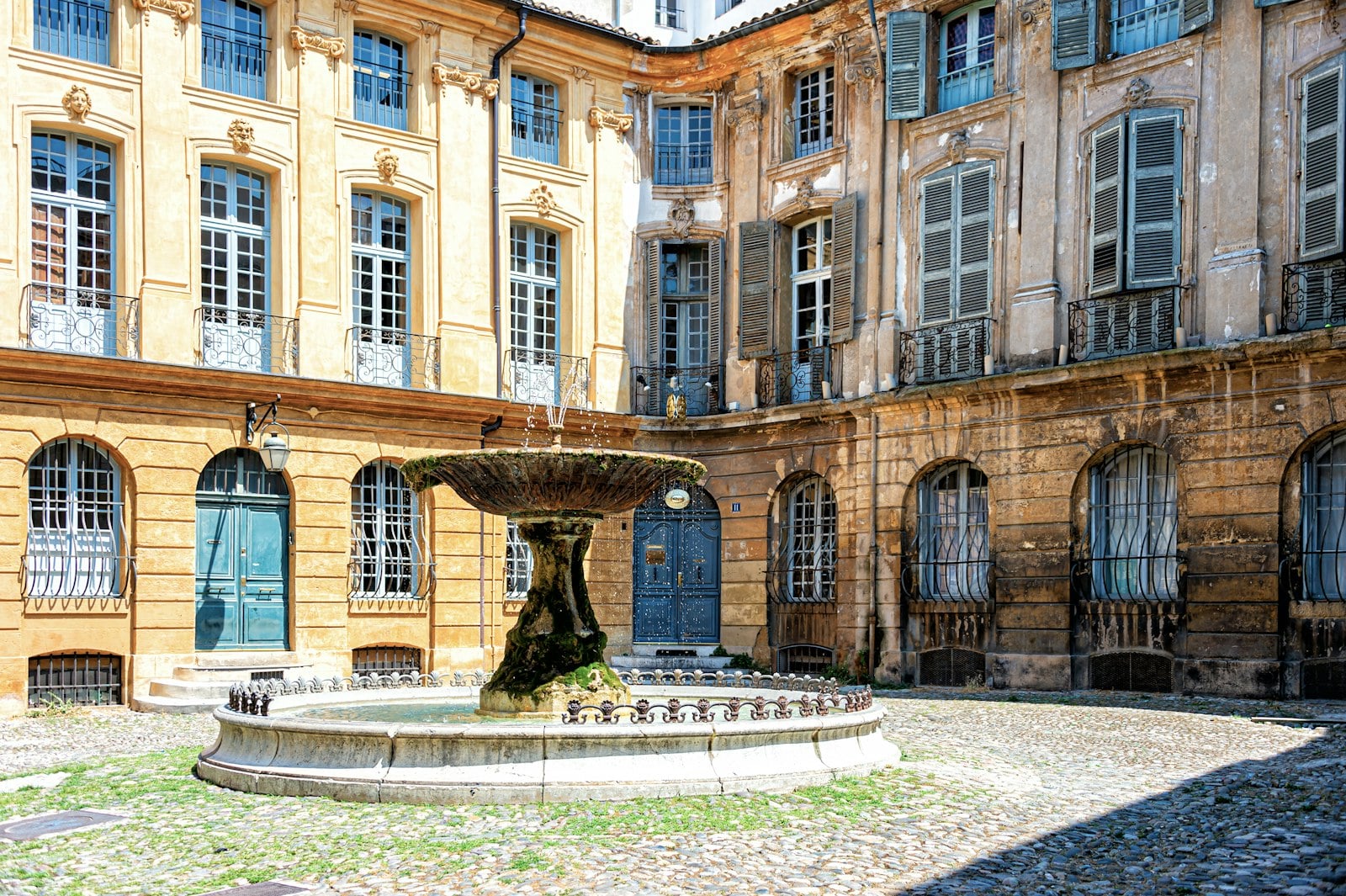
The old town is flat and takes an afternoon. The Place d’Albertas, a Baroque square of 1745 with its fountain, opens off rue Espariat; the Pavillon de Vendôme, a 1665 folly with a formal garden, is €5, closed Tuesday; Saint-Sauveur cathedral keeps its late-12th-century cloister and the octagonal baptistery on columns said to come from a Roman temple, free, 8:40 to 18:30. West of the center the Fondation Vasarely, sixteen hexagonal cells of op art from 1976, opens Wednesday to Sunday, €12.
Granet is the museum, in the old priory of Saint-Jean-de-Malte in the Quartier Mazarin: the Cézanne room, Ingres, Granet’s own Roman views, and the Planque collection in the chapel annex, with a Paul McCartney photography show to January 3, 2027 and the Cézanne-heritage rooms reopening on December 8. The Hôtel de Caumont, built between 1715 and 1742, runs two exhibitions a year with a café in its garden; our Cézanne day ends there.
Martigues, the Venice of Provence on the Étang de Berre 45 minutes south, is the second day of our art tour: the Ziem museum, free, afternoons only from September to June, and an hour on the canals by boat. Sainte-Victoire is the other way, east along the D10 or the D17 past Le Tholonet, where Cézanne set up his easel and the tiny Palette appellation grows on the limestone; the Croix de Provence stands at 946 meters on the western tip.
Eat calissons, the diamond sweets of ground almond and candied melon under royal icing that Aix has made since the 15th century, and drink Coteaux d’Aix rosé cold with lunch or a red from Palette. The market stalls sell tapenade, anchoïade and aïoli with raw vegetables, navettes scented with orange blossom, and fougasse with olive oil.

Getting there and around
The direct TGVs leave Paris Gare de Lyon at 6:38, 7:38 and through the day to 21:12, 2 hours 55 to 3 hours 04; an OUIGO from Gare de Lyon at 8:22 takes 2 hours 55, and a few OUIGOs start at Marne-la-Vallée. Coming back, the late direct trains leave Aix TGV at 17:44, 17:52 and 19:26, the last, into Paris at 22:32. The other route is the TGV to Marseille Saint-Charles and the TER to the in-town Aix station, 40 minutes, 37 a day. Marseille airport is 25 kilometers away, with the A2 bus every half hour, €10.
From Aix TGV the A2 bus leaves every 15 minutes from 5:45 to 1:00, 25 minutes to the bus station at 6 boulevard Coq by the Rotonde, €6 one way or €9.60 return, paid on board by card. The tourist office is next door at 300 avenue Giuseppe-Verdi. The City Pass, €29 for 24 hours, covers the Granet, Caumont, the Cézanne sites when open, three English walking tours and the town buses, but not the station shuttle.
In town everything is on foot: Caumont is a minute off the Cours, Granet five, the cathedral twelve from the Rotonde. The Cézanne country is where the walking ends: the studio is a climb north, the Jas a bus ride west, Bibémus 6 kilometers east with no shuttle and no tickets at the gate, and the Sainte-Victoire car parks have no bus we could find. Our art tour puts a driver-guide under the whole day.
The Legendary Art and Provence tour is six days and five nights, three in Aix and two in Arles, $2,950 per person with 3-star hotels or $3,150 with 4-star, breakfasts, admissions and the private transfers, rail to Paris not included, two people minimum. Five Days in Provence, $1,850 per person for four or more, sleeps in Avignon and gives Aix its third morning on the way to the Luberon, with a wine tasting at an estate.
When to go
Aix is Mediterranean: hot, dry summers with afternoons over 30 degrees, mild sunny winters, and the rain mostly in autumn storms. The mistral blows hardest in winter and spring and leaves the sky scrubbed. April to June and September to October are the months.
The Festival d’Aix fills the hotels from July 1 to 20, 2027, with the operas in the Théâtre de l’Archevêché. The Christmas season on the Cours runs November 13, 2026 to January 10, 2027, with the santon fair. Market mornings are Tuesday, Thursday and Saturday; plan a day around one.
The Cézanne sites ran a July 4 to October 31 season in 2026 and are closed now; the studio is due back in spring 2027, the Jas de Bouffan later. Granet opens at noon from November 3, 2026 and closes Monday; the Pavillon de Vendôme closes Tuesday and over lunch; Vasarely closes Monday and Tuesday; the Burning Bush triptych shows only from Easter to Whit Monday, July 1 to September 8, October 1 to November 1 and Advent to Epiphany.
From June 1 to September 30 the Sainte-Victoire massif and the Bibémus quarries open by a prefectural fire map published at 18:00 the evening before; the Croix de Provence trail is closed on weekdays for works until November 27, 2026.
Frequently Asked Questions
Is Aix-en-Provence a day trip from Paris?
Only just. The TGV takes 2 hours 55 and the shuttle another 25 minutes, and the last direct train back leaves at 19:26, so a day gives you the Cours, a market and Granet. Aix works better as a base: Marseille is 40 minutes by train, the Luberon an hour by car. Our Legendary Art tour sleeps three nights here.
Can you visit Cézanne’s studio?
Not until spring 2027; the studio and the Jas de Bouffan closed for restoration on October 31, 2026. Until then the Cézanne you can see is the pavement trail, his room at Granet, the Bibémus quarries on a guided visit, and the mountain itself from Le Tholonet. Our art tour’s guided day follows the Cézanne sites that are open on your dates.
Aix or Avignon as a base for Provence?
Aix for the town itself: the markets, the cafés, Cézanne, Marseille and the coast close by. Avignon for the ring of villages, the Pont du Gard and the Palais des Papes. Our tours use both: the art tour sleeps in Aix and Arles, the three- and five-day trips in Avignon and drive to Aix for a morning.
What should I eat in Aix?
Calissons from one of the old houses on the Cours, a lunch of tapenade and aïoli from the Richelme market, and a cold Coteaux d’Aix rosé. For a sit-down dinner, the Quartier Mazarin streets behind Caumont have the quieter tables.
Is there a tour from Paris?
Yes. Our Legendary Art and Provence tour is $2,950 per person for six days, three nights in Aix and two in Arles, with a driver-guide for the Cézanne and Van Gogh days. Five Days in Provence, $1,850, and Best of Provence in Three Days, $1,925, are based in Avignon; the five-day trip spends a morning in Aix.
Our Most Popular Day Trips From Paris


Ride between Avignon and the Provence villages with two hotel nights along the way.