The short version
- Book a train that stops in the center, at the Saint-Roch station. The other one, Sud de France, is outside town.
- Plan around Monday, when the Musée Fabre and the Jardin des Plantes are closed.
- Be on the Promenade du Peyrou at sunset.
- Our Provence trips start in Avignon, not far away.

What to see
Place de la Comédie
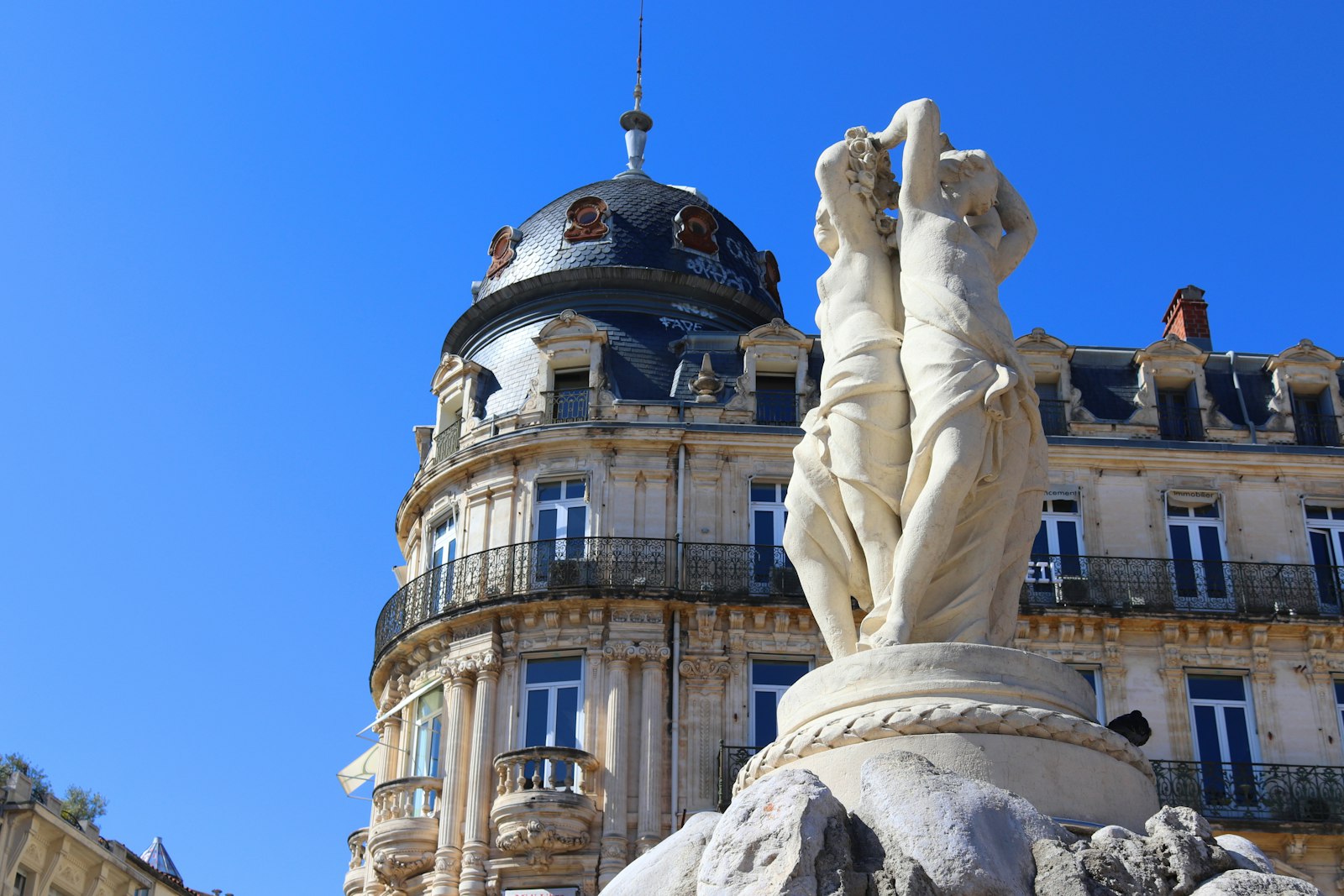
The big oval square is called l’Œuf, the egg, and the whole city crosses it several times a day. The opera house closes one end. The fountain of the Three Graces stands in the middle. It is a copy, and the 1776 original is kept inside the opera house.
Watch the trams go by. The city hired designers to dress them, and the fashion designer Christian Lacroix did two of the lines.
The Écusson
The old town is named for its shape, a shield. By southern standards it is young. The Romans never built here, and the town only appears around the year 985. It grew rich fast on the spice trade.
The streets are car-free and full of students. Behind the plain doors are nearly 80 private mansions from the 17th and 18th centuries. The tourist office’s guided walks take you into their courtyards.
The Faculté de Médecine
Doctors have been trained here since 1220, which makes it the oldest medical school still working. François Rabelais studied medicine here before he wrote Gargantua. Nostradamus enrolled in 1529 and was expelled. He had worked as an apothecary, a trade the professors looked down on.
The school fills an old monastery. The monastery’s chapel next door became the Cathédrale Saint-Pierre, with a porch held up by two enormous round pillars. Visits to the school are by guided tour from the tourist office.
The Jardin des Plantes
King Henri IV founded this garden in 1593 so the medical students could learn their healing plants. It is the oldest botanical garden in France. It is free and makes a shady stop on a hot afternoon.
The Musée Fabre
Look for Courbet’s picture of himself arriving in Montpellier in 1854, pack on his back and beard in the air. His rich local patron takes off his hat to him. Parisians laughed and called it Bonjour, Monsieur Courbet, and the name stuck.
Frédéric Bazille was a local boy who shared a Paris studio with Monet and Renoir. He was killed in the war with Prussia in 1870, at 28, before anyone had heard the word Impressionist. His sunlit paintings are here, with Cabanel’s Fallen Angel and a room of black canvases by Pierre Soulages. Give the museum two hours.
The Promenade du Peyrou
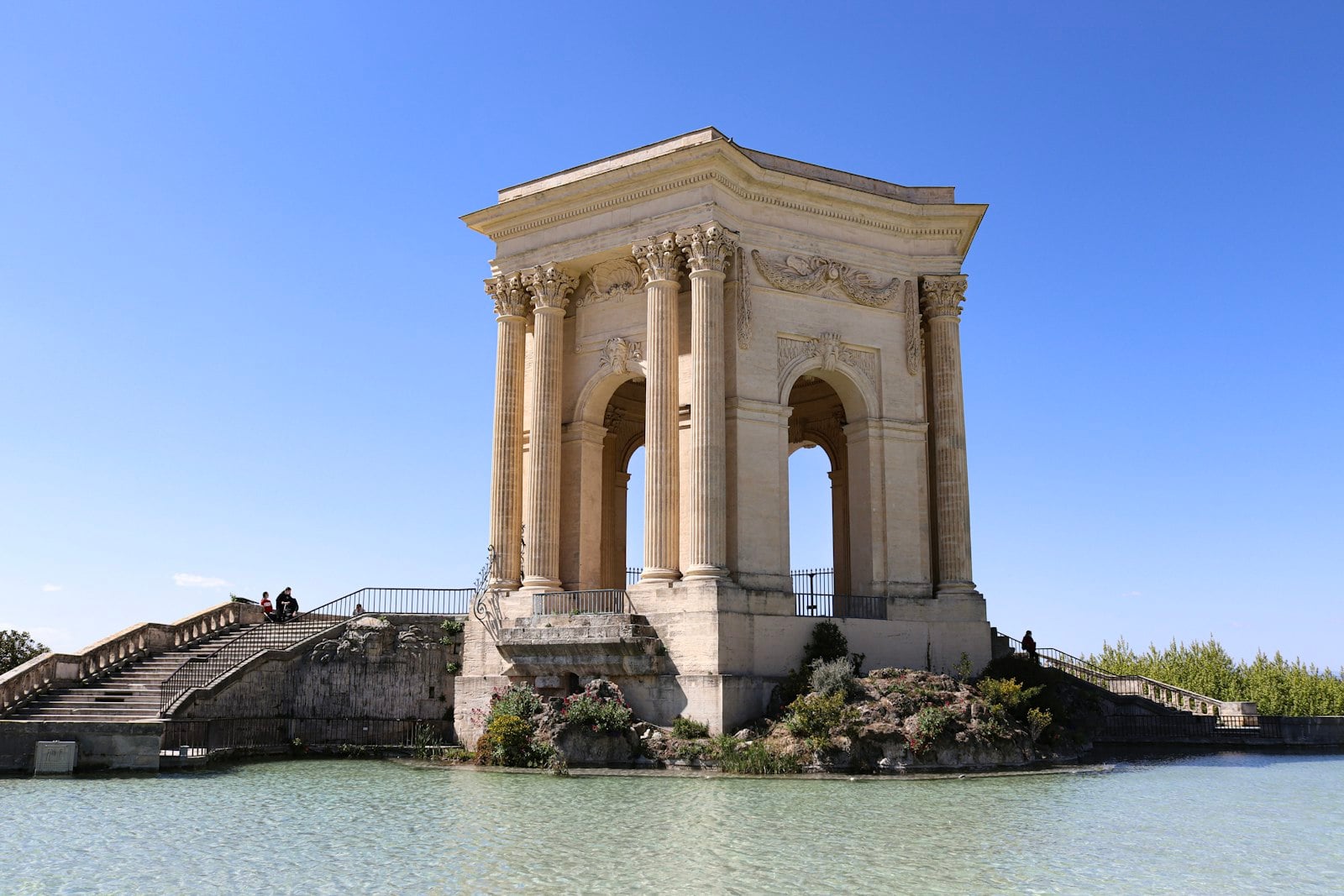
This royal terrace on the high side of town was finished in 1774. Louis XIV rides a bronze horse in the middle. Behind him is a water tower built like a small temple. The aqueduct that fed it runs off toward the hills, and its engineer, Henri Pitot, borrowed the look of the Pont du Gard. The triumphal arch by the gate can be climbed only on a guided tour.
What to eat and drink
The sea is close, and so is the Étang de Thau, the lagoon where the oysters of Bouzigues grow. Order them with a cold glass of Picpoul de Pinet. The red to know is Pic Saint-Loup, named for the peak north of town.
Getting there and around
TGVs leave from Paris Gare de Lyon. If your train uses the Sud de France station, tram 1 gets you into town in about 20 minutes. In the center you walk.
For the beach, take tram 4 to Garcia Lorca and bus 631 to Palavas-les-Flots. The other way is tram 3 to Pérols and the beach shuttle to the Grand Travers. Check that the beach buses are running before you go.
When to go
May, June and early September are warm without the July heat. The city gets about 2,700 hours of sun a year, so the odds are good in any season.
The market under the arches of the aqueduct runs on Tuesday and Saturday mornings. On Sunday a flea market fills the Peyrou.
Frequently Asked Questions
Which Montpellier station should I use?
Montpellier Saint-Roch if you can. It is in the center, 200 meters from Place de la Comédie. Montpellier Sud de France is outside town, with a tram into the center.
Are the trams in Montpellier free?
Only for people who live in the Montpellier area. Visitors need a ticket, €2.10 for 90 minutes, from the machines at the stops or the TaM app.
Can you get to the beach from Montpellier without a car?
Yes. A tram and a bus get you to Palavas-les-Flots, or a tram and a shuttle to the Grand Travers beach. The combined ticket for the Grand Travers is €3.
How many days do you need in Montpellier?
Two. Spend one on the Comédie, the old town, the Musée Fabre and the Peyrou. Keep the other for the beach, or for a market morning and the Jardin des Plantes.
What is Montpellier known for?
Its university, its medical school and its sunshine. Students make up a large share of the city, which is why it feels so young.
Our Most Popular Day Trips From Paris


Louvre, Montmartre and Notre Dame in eight hours with a private driver-guide.