The short version
- Come Wednesday to Sunday if you want the Art Nouveau museum and the Villa Majorelle.
- Reserve a time slot online for the Villa Majorelle before you go.
- Read the arrival station on your ticket. Some TGVs stop instead in the fields, a shuttle bus ride from town, in a station called Lorraine TGV.

What to see
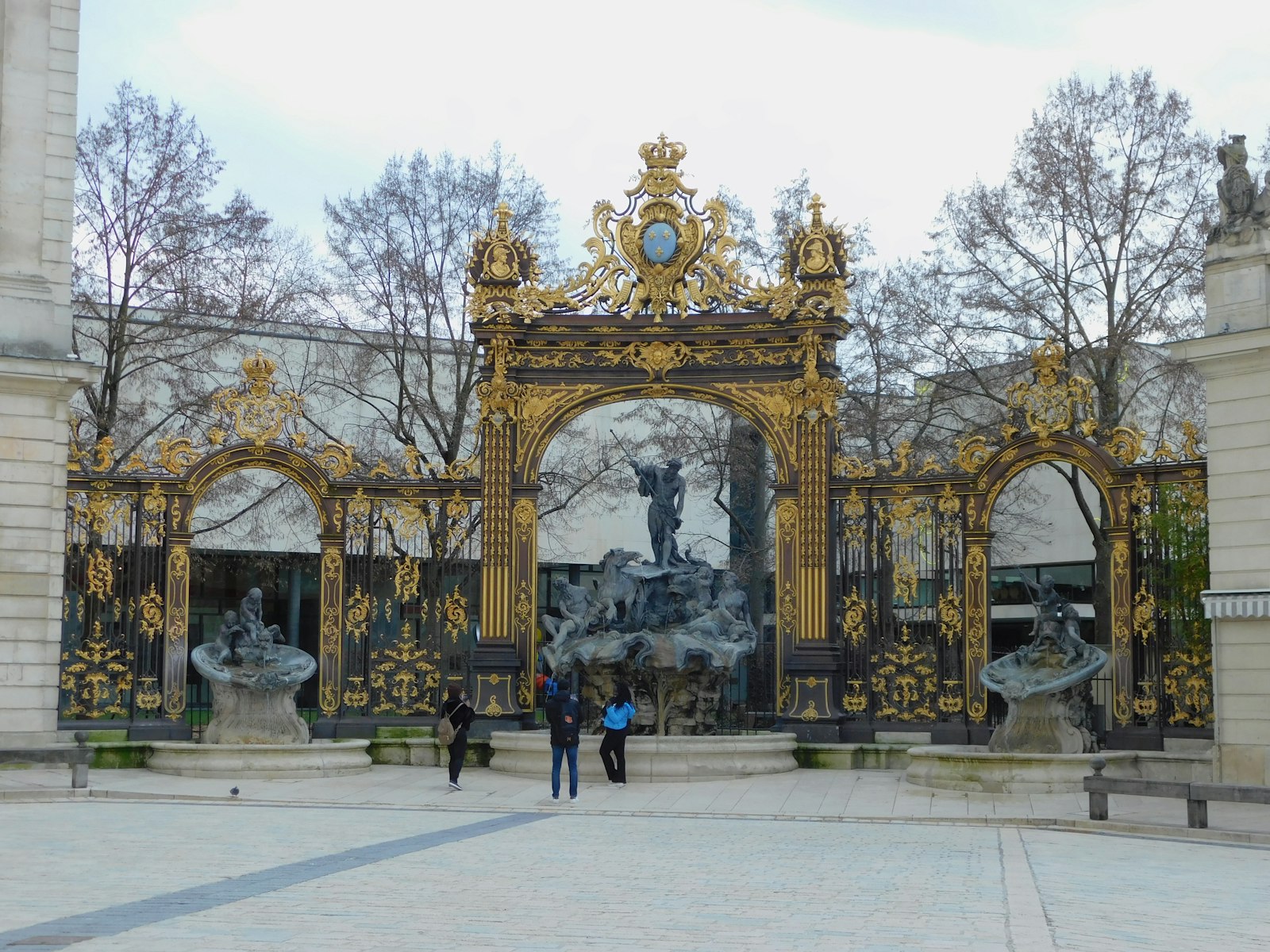
Place Stanislas
Stanislas Leszczynski was king of Poland twice and lost the throne twice. His daughter had married Louis XV, so France gave him the duchy of Lorraine as a consolation. He spent his retirement building. The square went up between 1752 and 1756 in honor of his son-in-law.
The gilded iron gates in the corners are the work of a local blacksmith, Jean Lamour. Stanislas died at 88, after his robe caught fire at the hearth, and Lorraine became part of France. His statue has stood in the middle of the square since the 1830s.
The Arc Héré and Place de la Carrière
Walk under the triumphal arch on the north side, named for the square’s architect, Emmanuel Héré. Beyond it is a long, tree-lined square that was once a jousting ground. These squares and the smaller Place d’Alliance have been on the UNESCO list since 1983.
The Old Town
Past the arch the streets turn medieval. In January 1477 Charles the Bold, Duke of Burgundy and the richest prince in Europe, came to take Nancy and lost the battle outside its walls. His body was found two days later, frozen in a pond. The dukes of Lorraine never forgot their win. Their palace, which holds the Musée lorrain, is closed for renovation with no date to reopen.
The Musée des Beaux-Arts
The art museum is right on the square. Go down to the basement, where about 300 pieces of Daum glass glow inside the old city fortifications. A mirror room by Yayoi Kusama is on the ground floor.
Art Nouveau
In 1871 Germany annexed Alsace and part of Lorraine. Thousands of people who wanted to stay French moved to Nancy, and the town filled with money, talent and new houses. The glassmaker Émile Gallé, the Daum brothers and the furniture maker Louis Majorelle turned flowers, dragonflies and thistles into lamps, vases and staircases. They called themselves the École de Nancy.
Their museum is in a collector’s house with a garden, a bus ride from the center. The Villa Majorelle, from 1901 and 1902, was the first Art Nouveau house in town. It is under restoration until late 2028, and only the ground floor is open.
The table
Quiche lorraine comes from here. So do bergamotes, square golden candies flavored with bergamot. The macarons de Nancy are flat and cracked and nothing like the Paris kind. Two nuns who lost their convent in the Revolution baked them to earn a living. The story goes that Stanislas, finding his cake too dry, had it soaked in sweet wine, and that was the first baba.
Getting around
The center is all on foot. For the Art Nouveau museum and the Villa Majorelle, take a Stan bus. The tourist office also runs an Art Nouveau walk of about two and a half hours.
When to go
Saint Nicholas is the patron of Lorraine, and here he matters more than Santa Claus. The festival lasts 45 days, with a big parade in early December and light shows on the square.
From mid-June to mid-September a video show lights the square in the evenings. Winters are cold, with frost and some snow.
Frequently Asked Questions
Is Nancy a good day trip from Paris?
Yes. The fastest TGV from Gare de l’Est takes 1 hour 31 minutes, and Place Stanislas is a short walk from the station.
Can you visit the Villa Majorelle?
Yes, on Wednesday to Sunday afternoons, with a time slot reserved online.
When is the Saint-Nicolas festival in Nancy?
From late November to early January, with the big parade in early December.
Is the Musée des Beaux-Arts free?
It is free for visitors under 26, and for everyone on the first Sunday of the month.
Where else can I go in eastern France?
Strasbourg is one region farther east. Reims and Champagne are back toward Paris.
Our Most Popular Day Trips From Paris


Louvre, Montmartre and Notre Dame in eight hours with a private driver-guide.